

Google’s flood forecasting researchers demonstrated that AI could predict extreme river floods up to five days ahead in areas without local river gauges, with reliability comparable to a leading global forecasting system’s same-day estimates1. For affected communities, this could mean time to evacuate, move livestock, or protect their valuables before water arrives.
During the pandemic, Togo faced a different information problem: how to get emergency cash to people who needed it, including those without formal employment records. An expansion of its Novissi program used satellite imagery, anonymized phone data, and surveys to identify the poorest communities in need of stimulus, reaching over 57,000 residents in rural districts. These predictions helped the government decide where to direct limited assistance.
In Nigeria, secondary school students practiced English with Microsoft Copilot during a six-week, teacher-guided after-school program. Students enrolled in the program scored higher on English tests than the comparison group in a randomized trial. The appeal here is obvious: more students getting practice and feedback that would otherwise be difficult to provide.

These examples offer a glimpse of why people (myself included) are so optimistic about AI. In Machines of Loving Grace, Dario Amodei describes how powerful AI could accelerate advances in global health, the sciences, and economic development. Sam Altman’s The Intelligence Age argues the commoditization of intelligence will bring greater prosperity and expand what people can accomplish. Both make an ambitious case for what is possible.
The part I want to understand is how these individual advances translate into improvements in people’s lives. Consider the flood forecast. Earlier warning gives a community more time to react, but its value depends on whether people receive the warning, trust it, and have a safer place to go. If poor phone reception prevents the warning from reaching people, or a lack of transport prevents evacuation, improving the forecast may do little to change the outcome. Knowing where the process breaks down helps identify the constraint to address next.
The same question arises well beyond AI. A randomized controlled trial (RCT)2 of household grid electrification in rural Kenya found no meaningful evidence of socioeconomic or educational gains after 3 years. Was this truly because electricity has no benefit, did we measure the right things, were there complementary inputs missing, or did the measures and time horizon miss some of the nuances?3. How do we design deployments and evaluations to learn the right things?
What are we asking AI to do?
“AI for health” or “AI for development” can mean a very broad range of things. In my mind, there are three useful classes of applied AI problems:
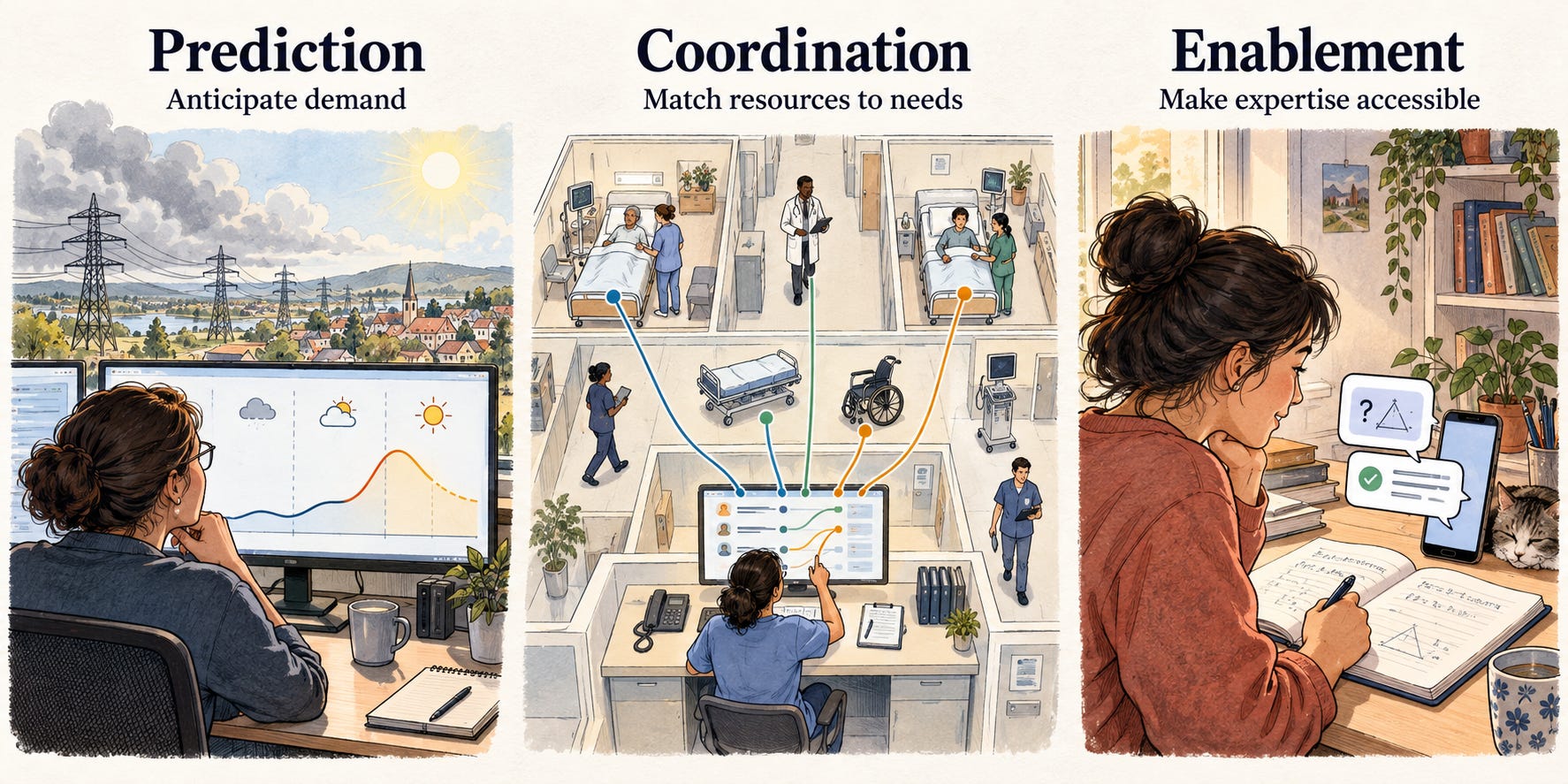
Prediction/data problems involve making sense of large or complex datasets to inform decisions. A grid operator, for example, needs to anticipate electricity demand using weather forecasts and past consumption.
Coordination problems involve allocating resources and getting people and systems to work together. A hospital can anticipate a busy night and still struggle to arrange staff, beds, and equipment. AI can help bring scattered information together and match resources to demand.
Enablement problems involve making existing expertise more accessible. Tutoring outside school hours and pest-control advice for farmers become possible for people who could not previously obtain or afford them.
There’s also an obvious set of discovery problems: abundant intelligent labor could help run experiments, develop new medicines or materials, and further scientific knowledge. My focus here is more narrowly on applied AI, where we already have capabilities worth deploying and need to understand the conditions under which they become useful.
What are we measuring?
Suppose a company introduces an AI customer service agent. A month later, the dashboard shows growing usage, faster responses, and hundreds of thousands of conversations ending without a human agent joining. But anyone who has spent twenty minutes arguing with a chatbot while asking to be connected to a human can probably see the ambiguity.
These numbers capture different things. Across these problems, I find it useful to further distinguish between broad classes of measurements:
Adoption measures whether people use the tool or service, and how that use trends over time. Examples include sign-ups, active users, engagement, number of queries, and repeat use. For a public service, we might also ask what proportion of the intended population it reaches and which groups drop out along the way. Increased compute-hours could indicate usage, or simply a more demanding system.
Output tells us what it produces and how well it performs. Examples include the volume of generated responses or tokens, the accuracy of diagnoses made, increased physical production, and scores on standardized tests. Quality and quantity both matter here: a tutoring program might support larger class sizes while decreasing test performance; a diagnostic tool might evaluate patients quickly while producing more false positives.
Value measures what improves for people, closer to the empirical outcomes we care to affect. Near-term measures might include $ saved, doctor-hours saved, or increased crop yields. Long-term measures might track population health outcomes, poverty rates, or GDP. Any value comparison needs to account for both benefits and costs — average improvements might mask serious harms to minority groups who are much worse off.
If the chatbot saves five minutes of staff time by imposing half an hour of back-and-forth on the customer, the company has reduced its own costs at the expense of its service quality. We’d need to follow the customer through the full resolution process, including repeat contacts and calls to another department, and aggregate time spent on both sides. Otherwise, some of the reported efficiency is simply work transferred to the customer.
Even a carefully randomized trial could mislead us here. If we choose fewer human escalations as the outcome, both a helpful chatbot and one that makes reaching a person impossible could look successful4. The trial might correctly establish that the bot reduced escalations — the mistake would be treating that as evidence customers received better support. Picking the right metric is just as important as designing the intervention itself; the explicit risk is that the measure also becomes the target.
Picking the right metric also means accounting for systematic biases in your measurement. A 2019 study examined an algorithm used to select patients for extra care by predicting future healthcare costs from past insurance claims (higher costs = more care needed). Claims data recorded less money spent on black patients vs equally sick white patients5. Using insurance spend as a proxy for need therefore disadvantaged black patients. Models can predict the chosen metric accurately while steering care away from the people who need it.
How do we design the evaluation?
What specifically is holding progress back?
Every proposed AI intervention implicitly comes with a diagnosis of the problem. Better forecasting assumes that weather uncertainty is preventing better decisions. Personalized health advice assumes that people lack medical guidance they can act on. Even after choosing a meaningful outcome to measure, we can misinterpret what prevents the outcome from improving. The question is whether the intervention addresses a binding constraint: an obstacle that actively rate limits the problem we care about. Sometimes multiple constraints need to be relaxed simultaneously before an improvement becomes possible.
Take a farmer who receives an accurate diagnosis of a pest infestation and instructions for treating it. If the farmer can’t afford the treatment, better advice won’t do much to help the harvest. A bad harvest the previous year might have depleted their savings, or made another risky investment harder to justify. Access to expertise has improved, but the ability to act on it has not. The incremental useful step might be financing, harvest insurance, or a cheaper mechanical treatment that the farmer can actually use.
The adage of the streetlight effect captures the essence here:
A policeman sees a drunk man searching for something under a streetlight and asks what the drunk has lost. He says he lost his keys and they both look under the streetlight together. After a few minutes the policeman asks if he is sure he lost them here, and the drunk replies, no, and that he lost them in the park. The policeman asks why he is searching here, and the drunk replies, "this is where the light is".

In evaluation, the available data and experiments can quietly determine which problems we study. We might keep comparing versions of an AI advisor because its messages are easy to vary, while individual farmers’ risk tolerance to variable weather is much harder to measure. Evaluation risk exists before we even run an experiment: we can end up designing a trial around the most readily available features without addressing the underlying cause.
In a study in northern Ghana, researchers deliberately tested two explanations. Small farmers most often blamed limited farm investment on insufficient capital, but also described holding back because of unpredictable rainfall. The researchers developed a model of how investment could respond to cash and insurance under different constraints, then tested the two interventions separately and together. Farmers given insurance alone found resources to invest more in their farms. That supported the explanation that uninsured risk was holding investment back, and direct capital injection alone wouldn’t necessarily solve the problem. Researchers gathered context and formed hypotheses, while leaving open the possibility of other constraints.
But what if the root cause is unknown to us at the start — what if the farmers never mentioned unpredictable rainfall? One place to look is behavior our explanation can’t account for: if farmers who understand the advice and can afford the treatment still don’t use it, something is clearly missing. Following their attempts to purchase it might reveal rural supply chain bottlenecks where the vendor only delivers after the treatment window has already passed. That would introduce a supply chain problem which neither a better advisor nor a larger subsidy necessarily fixes. This is purely hypothetical, but it shows why unbiased follow-up can change the questions we think to ask.
Costly workarounds offer another clue. Economists use growth diagnostics to identify which obstacles most constrain investment and growth in a particular economy. The approach compares competing explanations against the behavior each would predict. Low electricity use could mean businesses have little need for power, or that the grid is unreliable. Firms paying substantially more to run private generators support the second explanation. The point is to use these patterns to identify what may be holding progress back, then design a trial to test whether relaxing that constraint improves the outcome — whether it’s infrastructure, access, enforcement, or coordination.
A natural interpretation here could be “don’t commit to a hypothesis”. That’s not what I’m advocating for. After all, a concrete hypothesis and set protocol are the backbone of the scientific method. We still need to specify the hypothesis, primary outcome, comparison, and analysis before seeing results. Unexpected observations can suggest a new explanation worth testing while the original result stays on the record.
This is an argument for open research registries, such as the AEA RCT Registry for social science trials and ClinicalTrials.gov for health studies. Oliver Hanney and colleagues propose extending research tracking to include results before papers are published and pilots that never reach full trials. I’d want AI evaluations to leave a connected public record: the original plan, results (including negative results), documented changes, and links to follow-up studies. Funders should require both advance registration and results reporting. Other teams could then see what was tested, what remained unsolved, and why a different intervention might be worth trying.
Compared with what?
Finding a missing input also changes what we need to compare. Return to the farmer: suppose a program pairs AI advice with a voucher for pest control, and harvests improve relative to the existing service. That supports the combined program. It does not establish how much AI contributed. Farmers might have used the voucher effectively with the guidance already available to them.
If we are deciding whether the AI service adds enough value to justify its cost, a useful comparison would give farmers the same voucher alongside ordinary agricultural guidance. We would then learn what the AI adds conditional on the treatment already being affordable. This is what choosing a baseline means in practice: specifying the services and resources people would otherwise receive. Comparing the package with existing practice and comparing it with vouchers plus ordinary guidance answer different funding questions.
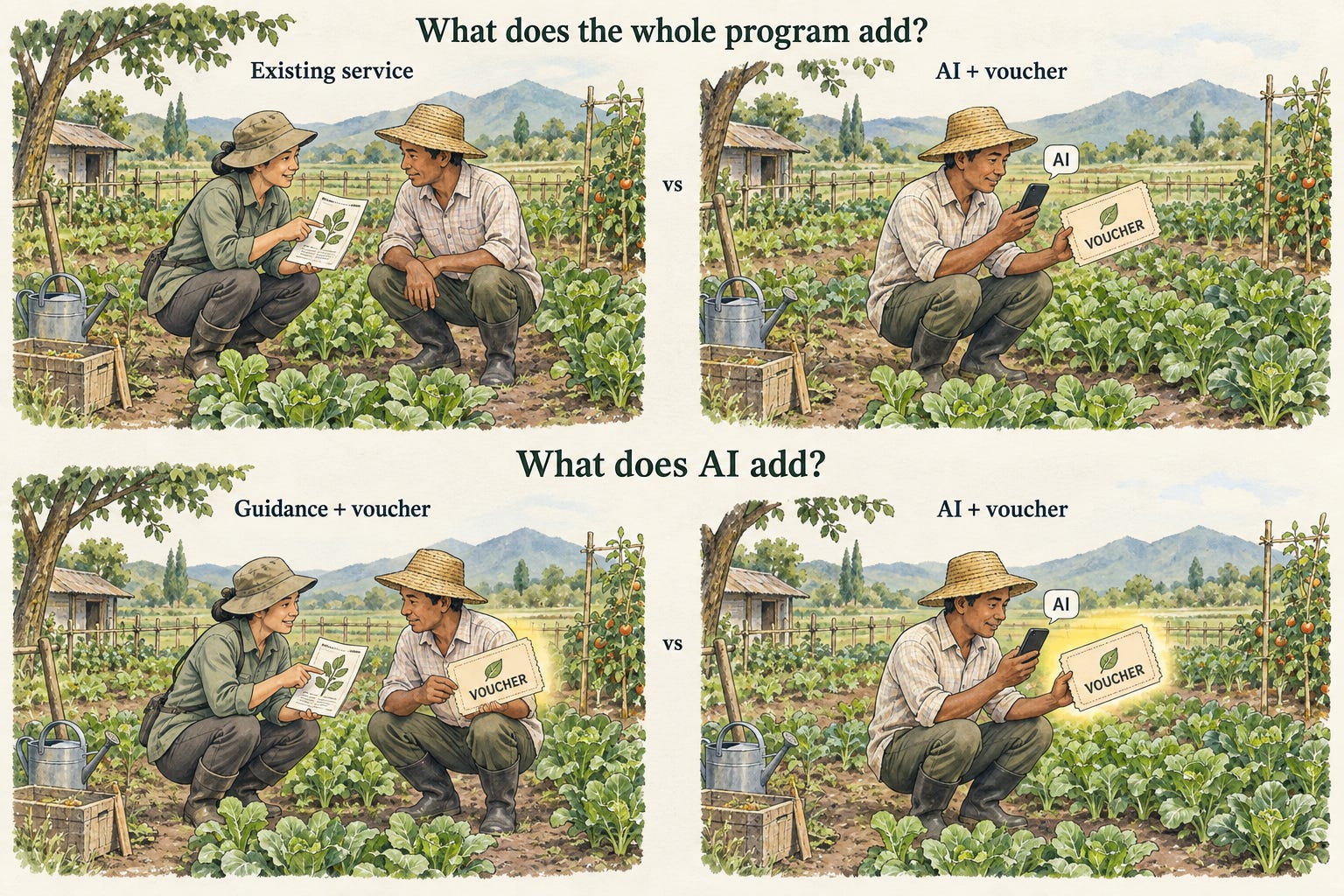
The distinction cuts both ways. Testing advice where people cannot act on it can miss its value under better conditions. Giving it credit for an entire support program can exaggerate its contribution. Neither result tells us what AI is worth in every setting, but seeing both helps decide what combination to fund.
With initiatives like Anthropic’s $200m Economic Futures Research Fund supporting research on society’s adaptation to AI, these distinctions have practical stakes. We could fund a more capable advisor, the means to follow its advice, or both. Evaluations should help establish which factor is binding and where marginal investment results in marginal improvement.
How do studies generalize?
A diagnosis that fits one deployment may change when the people, resources, or scale change. A screening pilot might have enough appointments for every referral. Expanding it nationwide could identify more patients than the system is able to treat. A model could retain exactly the same predictive performance as the pilot while the wait for follow-up visits grows. By making screening more accessible, the program may have shifted the binding constraint to treatment.
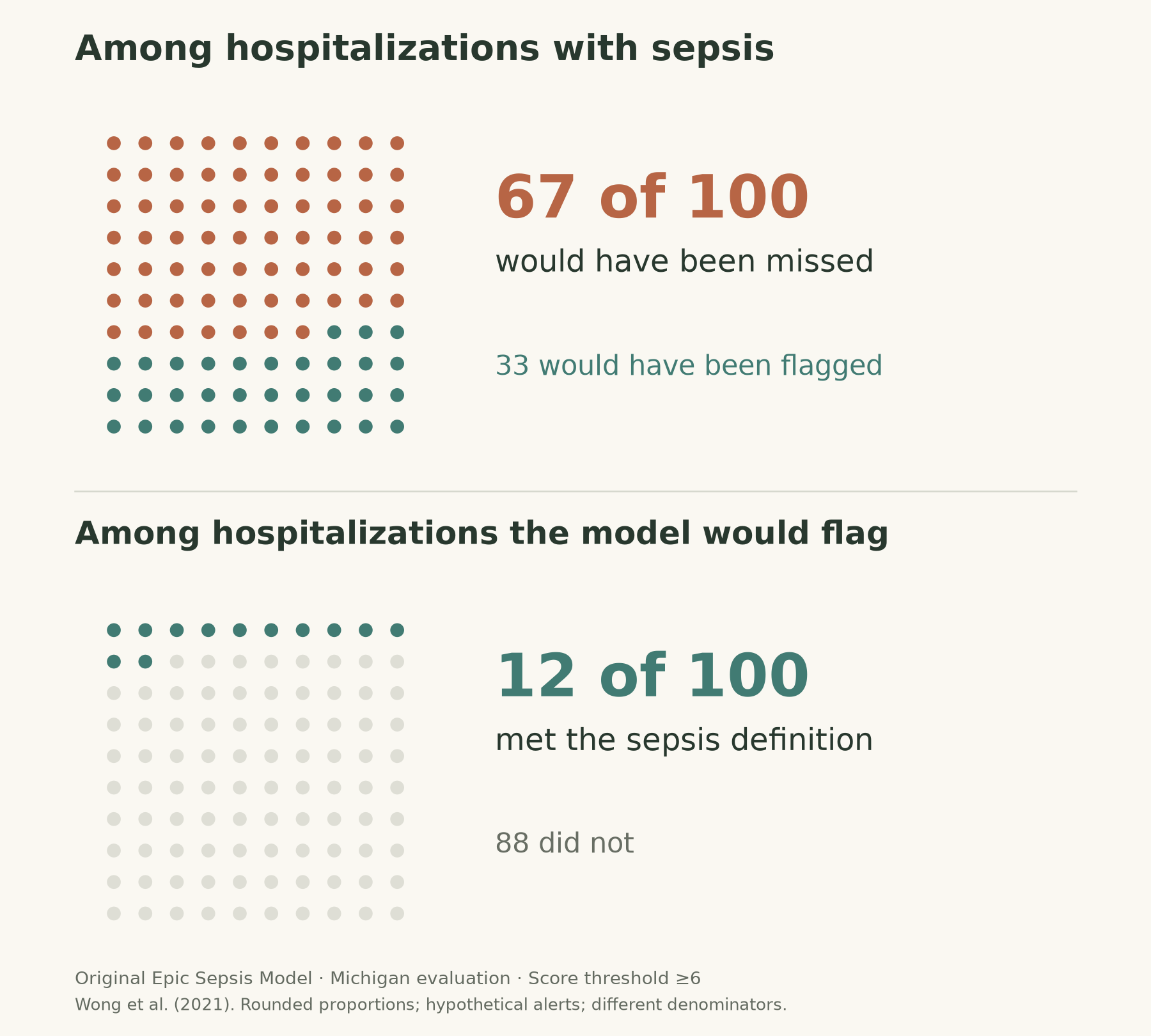
Predictive performance itself also needs validation. Epic’s original sepsis model6 was already used at hundreds of hospitals when a 2021 independent evaluation at UMich found that, at the hospital’s selected alert threshold, it would have missed 67 of every 100 hospitalizations with sepsis. Of every 100 hospitalizations it would have flagged, only 12 met the study’s sepsis definition. This could leave a busy ward reviewing many false positives while missing actual sepsis cases.
Even when a model performs well, the support system around it might change. In a screening pilot, a research team might pay for coordinators to book follow-up appointments and call patients who miss them. Removing these roles could leave a clinic identifying just as many patients but treating fewer. Oliver Hanney and colleagues make a related case for testing arrangements that remain useful across models and can be afforded at scale. A government ministry might learn more from a cheaper model with ordinary staffing than from the strongest model with intensive research support.
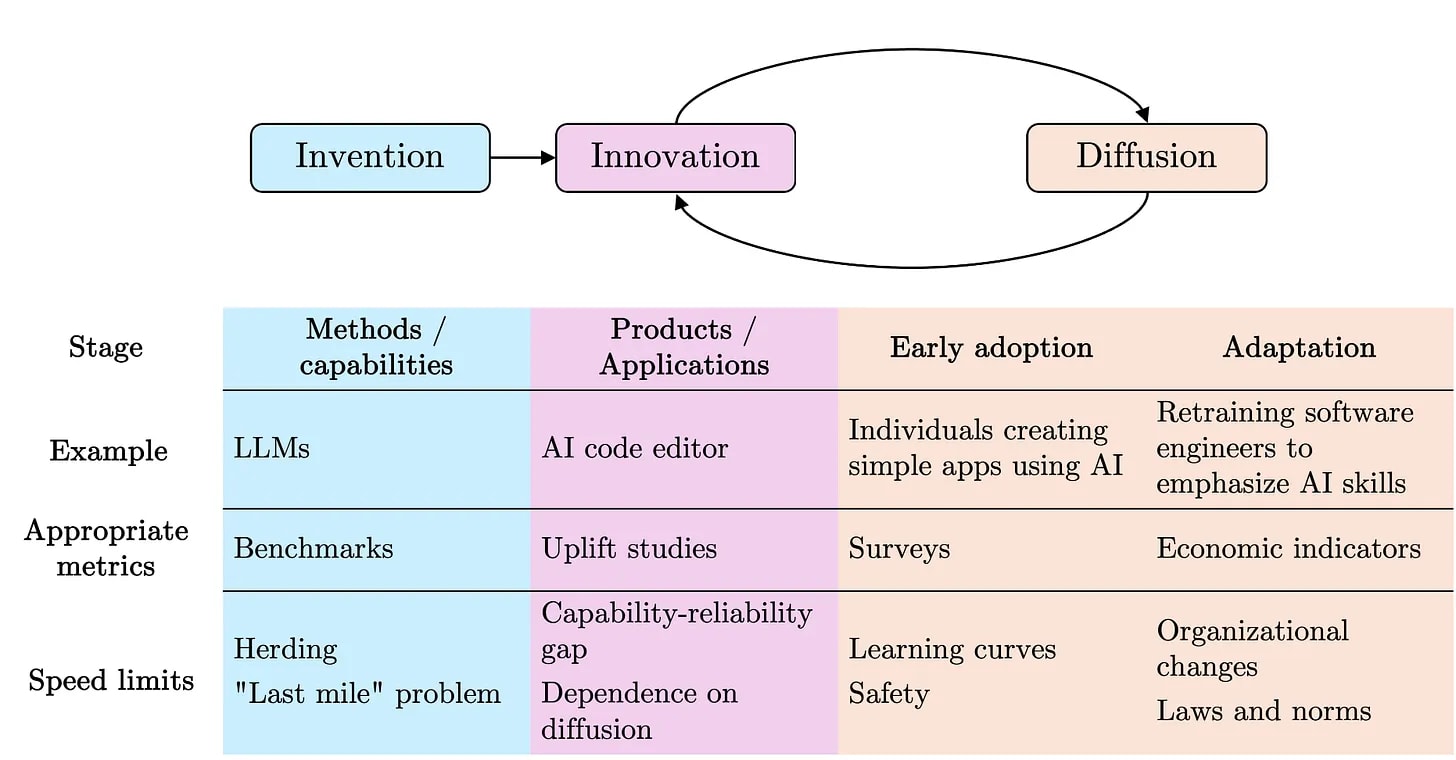
This is the organizational work behind the distinction Arvind Narayanan and Sayash Kapoor make in AI as Normal Technology: invention develops capabilities, innovation turns them into applications, and diffusion brings those applications into widespread adoption. In our clinic example, wider use requires funding appointments and follow-up alongside the screening tool itself. The next useful investment may therefore be in the supporting services or distribution rather than the model itself. Evaluation needs to help us recognize when the constraint has shifted.
What happens after deployment?
As a service expands and its conditions change, we need to continually evaluate for failure modes the original trial might have missed. There are three broad types of failure to look for:
Active harm: the system takes or recommends an action that makes things worse than baseline. In our clinic example, acting on an incorrect recommendation might expose a patient to unnecessary side effects. Reviewing a model’s output alone would miss this part of the story.
Inaction: someone who needs help is never identified or served. If only patients flagged by the AI receive confirmatory tests, we might discover false positives while leaving missed cases unobserved. This is a form of the selective labels problem: our decisions end up shaping which outcomes become observable. Ongoing assessments should include a sample of patients the model did not refer, so the system doesn’t influence which mistakes we can discover.
Systemic failures: individual decisions can be reasonable while their combined effects are not. More accurate referrals might overwhelm treatment capacity or delay care for other patients competing for the same appointments. Evaluations need to extend beyond model inputs/outputs to evaluate the supporting infrastructure and human factors.
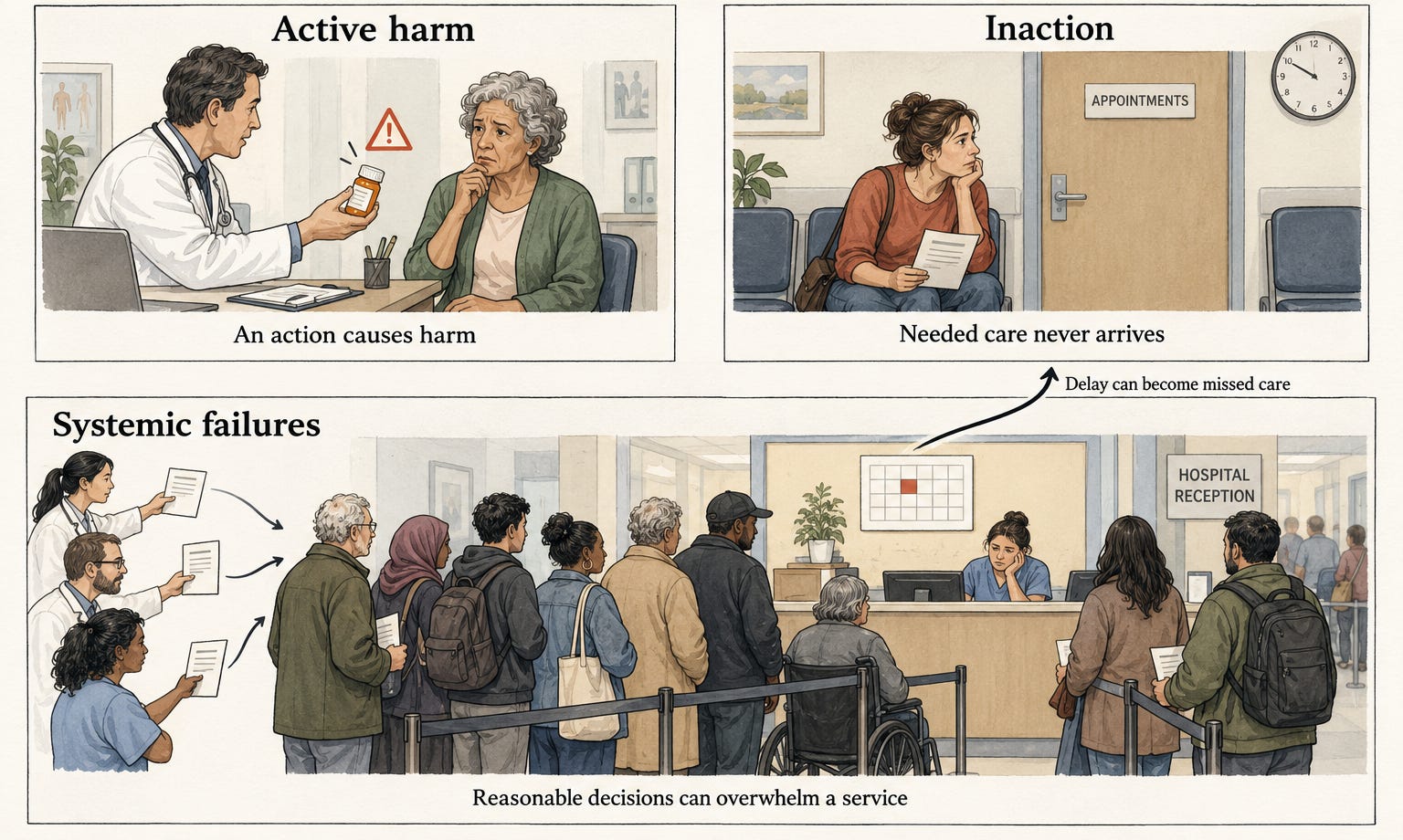
Across these failures, reversibility affects how much we can rely on monitoring and correction after deployment. Reversibility is not binary: recovery may be expensive, incomplete, or only possible within a short window. Correcting a missed referral after the treatment window has passed does not restore that opportunity. Where harm is limited and repairable, monitoring and correction seem reasonable; where serious harm could become irreversible, stronger evidence and review are needed before the system is allowed to influence those decisions. We already see these standards reflected in irreversible, high-risk applications like autonomous driving, clinical trials, aviation; introducing AI should not lower the standard of evidence or accountability.
Progress is not automatic
The opening examples give us plenty of reason to be optimistic: earlier flood warnings, better targeting of emergency stimulus, democratized access to education. The question I keep coming to is where the next step change in improvement will come from, and why we haven’t seen it yet.
If treatment capacity becomes the binding constraint, the next dollar may do more good paying for appointments than for pretraining. Our evaluations need to make these tradeoffs clearer, and funding decisions should address the rate limiting step rather than strictly chasing super-intelligence.
Thanks to Claude and ChatGPT for editing, graphics, and research help.
GloFAS is a real-time global flood monitoring and early warning service developed by the European Commission, widely used and recognized as the gold standard for physics-based flood forecasting.
RCTs assign participants or groups to intervention vs comparison groups at random. This helps estimate the intervention’s causal effect by reducing systematic differences between groups. RCTs are the gold standard for real-world studies, known for minimizing bias and confounding variables to determine true causal relationships. In practice, many trials generalize poorly due to short studies, variable environments, and convenient metrics.
Todd Moss uses this case to question whether development research prioritizes interventions that are easy to evaluate over those that directly target the root cause. The trial found that very poor households in western Kenya who connected to the grid didn’t use much electricity or show much benefit after 2-3 years. But if you target extremely poor people who can’t afford electricity, work low-productivity jobs in dysfunctional markets, and don’t have appliances, clearly connecting them to the grid won’t magically solve all their problems. The authors discuss limitations including affordability and investments needed to use electricity productively; but the null result alone does not establish which constraint was binding.
One of the hardest parts of an RCT is the trial design and measurement: Why randomize for electricity at home vs the place of work? Why did we choose to measure economic growth at the household level vs village or regional level? How should we weigh other aspects of economic development like time savings, safety, information distribution?
There are countless examples of optimizing the wrong objective:
OpenAI’s CoastRunners boat, which earned points by hitting targets along the course. It learned to maximize its score by circling and collecting the same targets, crashing and catching fire while earning a high score without finishing the race.
GDM’s Lego stacking task, meant to stack two blocks on top of each other. The agent was rewarded for the height of the bottom face of the block, and learned to simply flip the block over instead of stacking it.
Karl Sims’ simulated locomotion experiments, an evolutionary algorithm selected creatures for their ground speed over a short trial. This produced tall, rigid bodies that moved quickly by falling over rather than useful motion.
This could be due to a variety of reasons: lack of access to transportation, work and childcare demands, economic disparities, or differences in trust and treatment within the healthcare system.
Epic developed a proprietary tool in their EHR to automatically estimate a hospitalized patient’s risk of developing sepsis every 15 minutes based on demographic data and clinical charts.