

What struck me most about Mark Carney’s speech at Davos 2026 wasn’t the substance — a lot of people have been thinking about the rules-based order for years, others having written about it explicitly1. It was how bluntly he laid it out, in public, on that stage: the end of a “pleasant fiction”, a “rupture”, and — borrowing Vaclav Havel’s greengrocer — a call for countries (and companies) to “take their signs down”.
Havel, the Czech dissident and later president, asked how the communist system sustained itself. His answer centered on a greengrocer who every morning places a sign in his shop window reading “Workers of the world, unite!”. The greengrocer doesn’t believe it, nobody believes it, but he puts the sign up anyway — to avoid trouble, to signal compliance, to get along. Because every shopkeeper on the same street does the same, the system persists not through violence alone but through ordinary people participating in rituals they privately know to be false. The system’s power comes not from truth but from everyone’s willingness to perform as if it were true; and its fragility comes from the same source: when one person stops performing, when the greengrocer removes his sign, the illusion begins to crack.
Carney argues that for decades, countries like Canada had prospered under the “rules-based international order”, joining its institutions and praising its principles while knowing the story was partially false — that the strongest powers would exempt themselves from these same rules and institutions when convenient. In essence, middle powers had been placing their own “signs” in the window, going along with a system whose contradictions they privately recognized.
Since Davos, the commentary has mostly focused on whether the rules-based order is actually over and whether Carney was right. To me, being “right” doesn’t really matter — the world is clearly changing, and the more pertinent question is the strategic one: what should middle powers actually do about it? The middle power strategy feels more viable than pessimists suggest, but only if it’s honest about where it works and where it doesn’t.
Perhaps many have felt the sign slipping for a while. You see it in the UN Security Council, where veto power from permanent members can reduce core issues to signaling and procedural deadlock rather than enforceable outcomes. You see it in the WTO, whose Appellate Body has been unable to hear new appeals since 2019 after losing quorum. Even when adjudication delivers legal clarity, compliance is not guaranteed: the 2016 ruling in the South China Sea by the Permanent Court of Arbitration didn’t settle the wider dispute, and in Ukraine, the UN General Assembly’s resolutions and the International Court of Justice’s orders haven’t produced an outcome on the ground. Over the last two decades, regional conflicts, selective compliance, and the reversion from globalization toward reshoring and self-sufficiency have chipped away at our shared institutions.
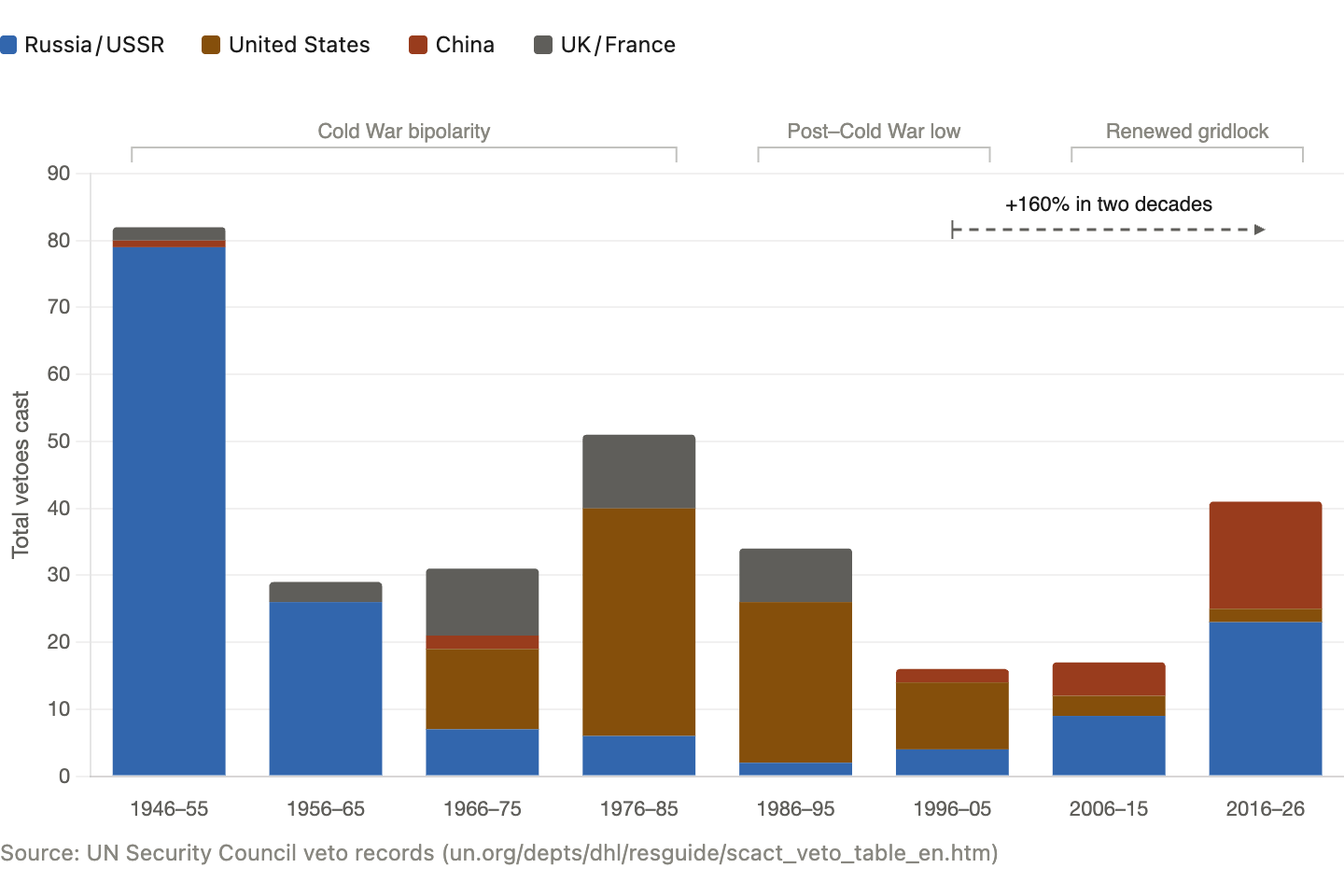
All this is even more striking from him. Canada has been the US’ closest neighbor since the world wars, and Carney himself is a leader whose resume screams establishment: Harvard BA, Oxford MPhil/DPhil, Goldman Sachs MD, central banker for Canada and England, turned prime minister. For someone who built their career upon the establishment, it’s jarring to hear him ask what’s next.
The uncomfortable implication feels clear: if the rules-based order is no longer self-enforcing, middle powers can’t assume the rules will protect them. In a world where individual great powers can outmuscle collectives, outcomes hinge less on principles and more on leverage. Middle powers become the swing coalition only when they control enough market access and legitimacy to make coercion expensive.
The rules-based order
I want to spend some time defining what this phrase means. To me, this term felt immediately intuitive: our modern world is governed by a web of institutions, laws, contracts, and principles, many of them formed after World War II.
Collective Security: the United Nations and NATO, to navigate conflict via shared laws, mutual protection, and legitimacy
Monetary policy: the Bretton Woods agreement, for a shared monetary system in the IMF and World Bank, to stabilize financial stressors and reduce the risk of contagion
Trade: the World Trade Organization and its dispute system, to handle economic disputes via adjudication rather than tit-for-tat retaliation
For middle powers after the world wars, buy-in to shared institutions was rational. When a country can’t match the economic or military weight of a great power, the rational move is to bind everyone (including yourself) to forums where arguments, precedent, and consensus carry weight. Shared institutions gave middle powers access to tools they couldn’t build alone: a structured lender of last resort, a dispute resolution system with the authority to deliver rulings, and a security architecture where small states had formal standing alongside large ones. The alternative — navigating crises bilaterally with a much larger counterparty — generally means accepting whatever terms the stronger party sets.
During Mexico’s 1995 peso crisis, where Mexico’s GDP was roughly $286 billion — less than 1/20 of America's $7.6 trillion. Without the IMF, Mexico’s leverage during a currency crisis would have been to ask a world power (Washington) for help and accept whatever terms came. With the IMF, it got an $18B program to reduce the national deficit and stabilize inflation, alongside $1.5B in emergency loans from the World Bank to restructure its financial sector and guarantee basic social services.
The WTO dispute system gave smaller states courtroom leverage. Brazil litigated its 2002 dispute against the US on cotton subsidies (DS267) and won meaningful concessions. Antigua and Barbuda — a country of under 100,000 people — challenged 2003 US restrictions on cross-border gambling (DS285) and secured a ruling in its favor. Ecuador, Guatemala, and other Central/South American countries protested unfair banana import tariffs and quotas against the EU in 1996 (DS27). In each case, this dispute mechanism gave smaller countries a platform to argue for legal merits over economic influence.
Cold War security guarantees follow the same pattern. The Helsinki Accords and, later, the Organization for Security and Cooperation in Europe’s Vienna Document adopted by 57 states in Europe, codified a diplomatic process that states could invoke when hard power was out of reach.
None of these levers independently produced a perfectly fair world, but they did produce a usable one: 1) financial panic had backstops, 2) trade disputes are adjudicated, and 3) collective security has guarantees.
Case 1: The Cold War
When I brought up Carney’s speech with a college friend, we were naturally drawn to historical analogs. The Cold War was the last time the world hardened into blocs, where middle powers were pressured to pick a side and accept dependency. Many responded the same way Carney is advocating for now — self-organizing to build collective leverage:
Non-Aligned Movement (1961): India, Yugoslavia, Egypt, Indonesia, and others formed the NAM as a counterbalance to US/Soviet bipolarity. The bloc helped legitimize decolonization and opposition to apartheid as key issues at the UN.
ASEAN (1967): Indonesia, Malaysia, the Philippines, Singapore, and Thailand established a regional economic and security framework — an agreement that persists to this day.
Organization of African Unity (1963): the basis for the African Union, 33 countries formed the OAU to promote economic integration and eradicate colonialism from the continent.
European Economic Community (1957): A common customs scheme among 6 founding members, creating free trade amongst its members and a common external tariff (making it harder to pressure countries individually).
Group of 77: a coalition of developing countries formed to promote economic cooperation and South-South cooperation2, also persists to date.
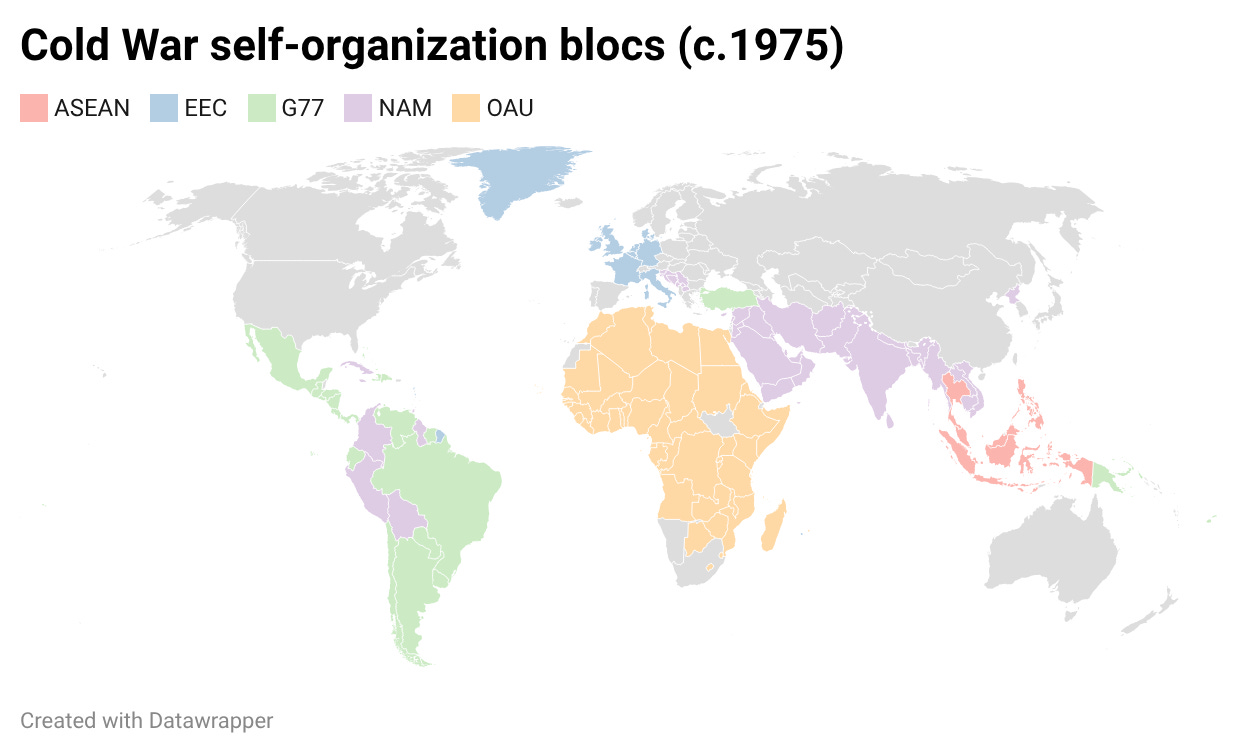
In the 1950s-1970s, squarely in the midst of the Cold War, middle powers self-organized into voting blocs, regional code-of-conduct blocs, and market access blocs. Great powers increasingly end up negotiating with units of common interest rather than individual states.
There’s an important tension here: non-alignment is easy to declare, but difficult to maintain. The 1979 Non-Aligned conference was held in Havana and chaired by Fidel Castro, who became the de facto spokesperson for the movement — Cuba being a prime example of a nation caught between competing American/Soviet influence. In December 1979 when the Soviets invaded Afghanistan, the UN overwhelmingly voted to condemn the Soviet Union. Cuba voted against the resolution (in support of the USSR) due to its deep financial/political debts to Moscow. This undermined Cuba’s leadership, its reputation within the non-aligned movement, and drew criticism from other NAM member states.
It’s not obvious that Cuba was wrong — I think rational states should act in their own self interest — but nonetheless highlights a core dilemma: “non-alignment” will always be tested when members’ individual interests diverge and stand to independently benefit from great powers.
Case 2: the 200-mile Exclusive Economic Zone
Today the EEZ makes headlines for territorial disputes in the South China Sea, overfishing in the Pacific off Peru/Ecuador/Chile, and suspected sabotage of undersea cables/pipelines in the Baltic Sea. The EEZ is such an integral part of offshore sovereignty that it’s easy to forget this 200-mile buffer zone is a political invention — and a clear example of middle powers self-organizing to rewrite the status quo.
Before the EEZ, coastal states could only rely on their territorial waters — historically 3 miles, later extended to 12 miles. Anything beyond this belt was effectively the high seas:
Other states could legally fish outside territorial waters, much closer to the coastline
Coastal states claimed “exclusive fishery zones”, but these weren’t standardized, often contested, and meaningless without enforcement
So coastal states started making unilateral moves: Chile (1947), Peru (1947), Costa Rica (1948), Honduras (1950), and Brazil (1950) individually made claims to adjacent fishery resources. In 1952, Ecuador, Peru, and Chile asserted exclusive sovereignty and jurisdiction of their coastal waters out to 200 nautical miles via the Santiago Declaration — explicitly tied to their economic livelihood and the conservation of marine natural resources.
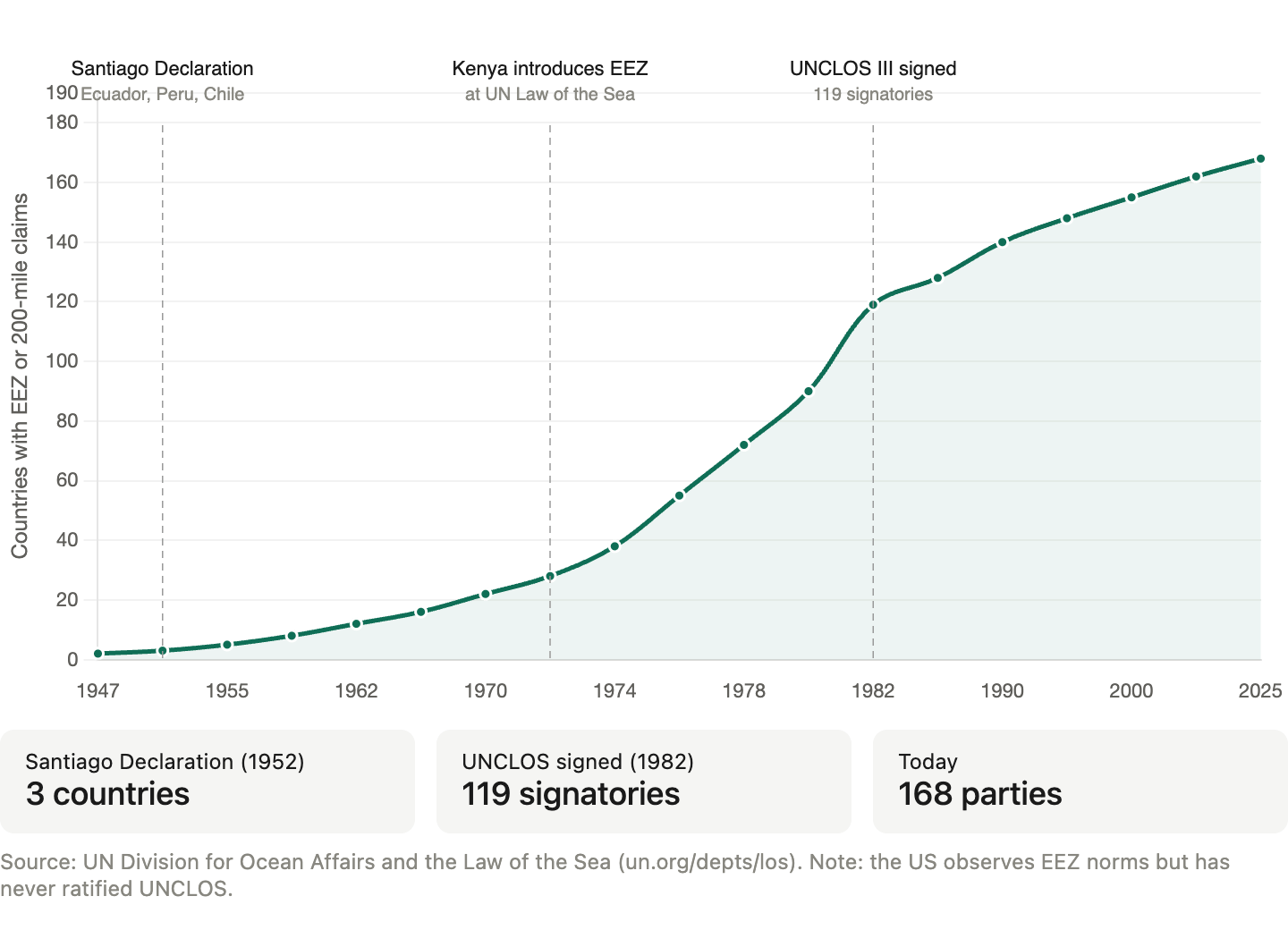
To major maritime and distant-water fishing states, the Santiago Declaration was a direct challenge to the status quo: a reallocation of valuable resource rights away from their own fleets to coastal nations. The US reaction was particularly explicit; Washington did not recognize the expansive coastal claims and even took steps to reimburse American fishermen for fines imposed under claims the US rejected. By 1955, US officials discussed going beyond verbal protests and proposed referring the dispute to the International Court of Justice. Other maritime powers like Japan were described as “the most implacable foe” of the 200-mile EEZ during UN sessions, and when Kenya introduced the concept in 1972 at UN Law of the Sea negotiations, most industrialized states were openly hostile.
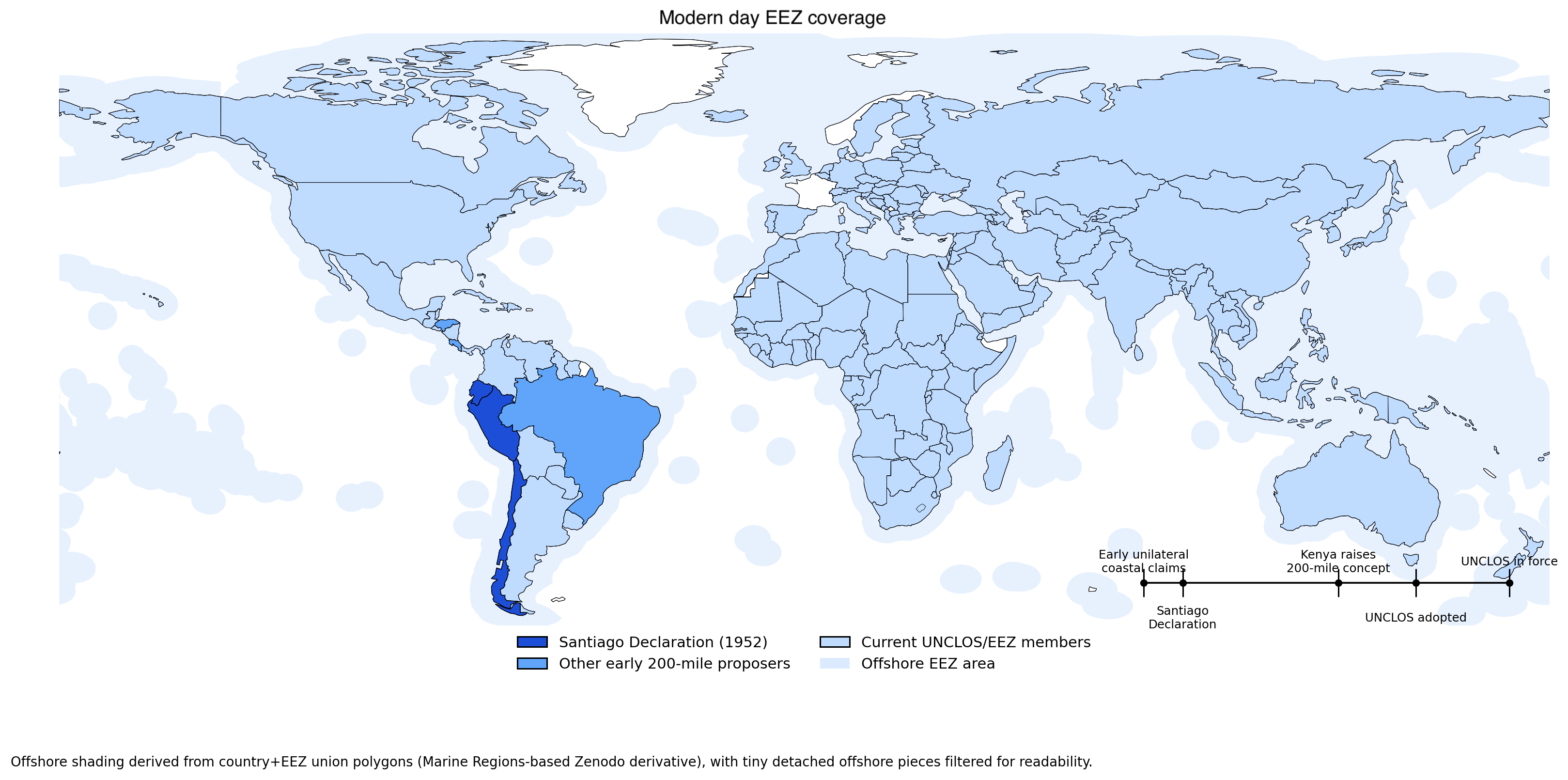
The EEZ wasn’t a moral epiphany — it was a coalition bargain. It came about because middle powers pressed for redistribution despite the status quo working for great powers. It eventually won because it was measurable (200 miles), enforceable, and attractive to a broad coalition of coastal states across Asia/Africa/South America. When a coalition is issue-aligned and large enough to build a credible majority, the status quo must shift.
Case 3: Iran
On February 28 2026, the United States and Israel launched joint strikes on Iran targeting its leadership, nuclear program, and military infrastructure. Iran’s supreme leader was killed. Retaliation came in the form of missiles and drones across the region, striking targets in nine countries. Within days, the conflict had drawn in the Gulf states, disrupted shipping through the Strait of Hormuz, and triggered protests on multiple continents. This conflict stress-tests every assumption Carney laid out at Davos, just six weeks after he articulated them.
The rules-based system was running, it didn’t matter
The rules-based order is supposed to provide alternatives to unilateral military action: mediation, negotiation, adjudication. In the weeks before the strikes, all of these were actively in motion. Oman spent months mediating indirect talks between the US and Iran. By late February, Oman’s foreign minister said the day before the strikes that “a breakthrough” had been reached, Iran agreed to never stockpile enriched uranium, to full IAEA verification, and to downgrade its existing stockpile. He said peace was “within reach”.
The institutional process was active, a mediator was engaged, and a great power moved forward with military action nonetheless. This is the core of what Carney was describing at Davos: the rules based order doesn’t fail because institutions don’t exist, it fails because the great powers wield more leverage than the institutions themselves. Institutions fail because great powers can bypass them when the calculus favors unilateral action, and there exist few mechanisms to prevent this from happening.
Compared with the examples we previously described: the EEZ took roughly 30 years from the Santiago Declaration (1952) to the near-universal adoption in UNCLOS (1982). ASEAN was founded in 1967 but took decades to evolve into a meaningful bloc. The European Economic Community began in 1957 but didn’t become the EU until 1993. In Iran, countries were mediating on February 27 and strikes began on February 28. Nine countries were under fire within 48 hours. Unilateral action leads to drastically accelerated timelines. No coalition mechanism — no matter how well designed — can form, deliberate, and act within that window.
Coalitions fracture under pressure
Carney’s thesis rests on middle powers cooperating for strength. Iran immediately tested whether this remains feasible when the stakes become high enough.
Within Europe, one of the world’s largest coalitions, positions diverged sharply within days.
Germany aligned with the framing that Iran was a “terrorist regime” and signaled support for ending it — breaking from the position it had shared with the UK and France over a year of nuclear negotiations
Spain explicitly said the operation wasn’t covered by international law, consistent with its stance on Ukraine and Gaza
The UK agreed to let the US use British bases for strikes on Iranian missile sites
France initially called for a return to negotiations, then opened up to defensive action after Iranian strikes hit French personnel in Jordan
Greece dispatched warships to defend Cyprus after an Iranian drone struck a British base
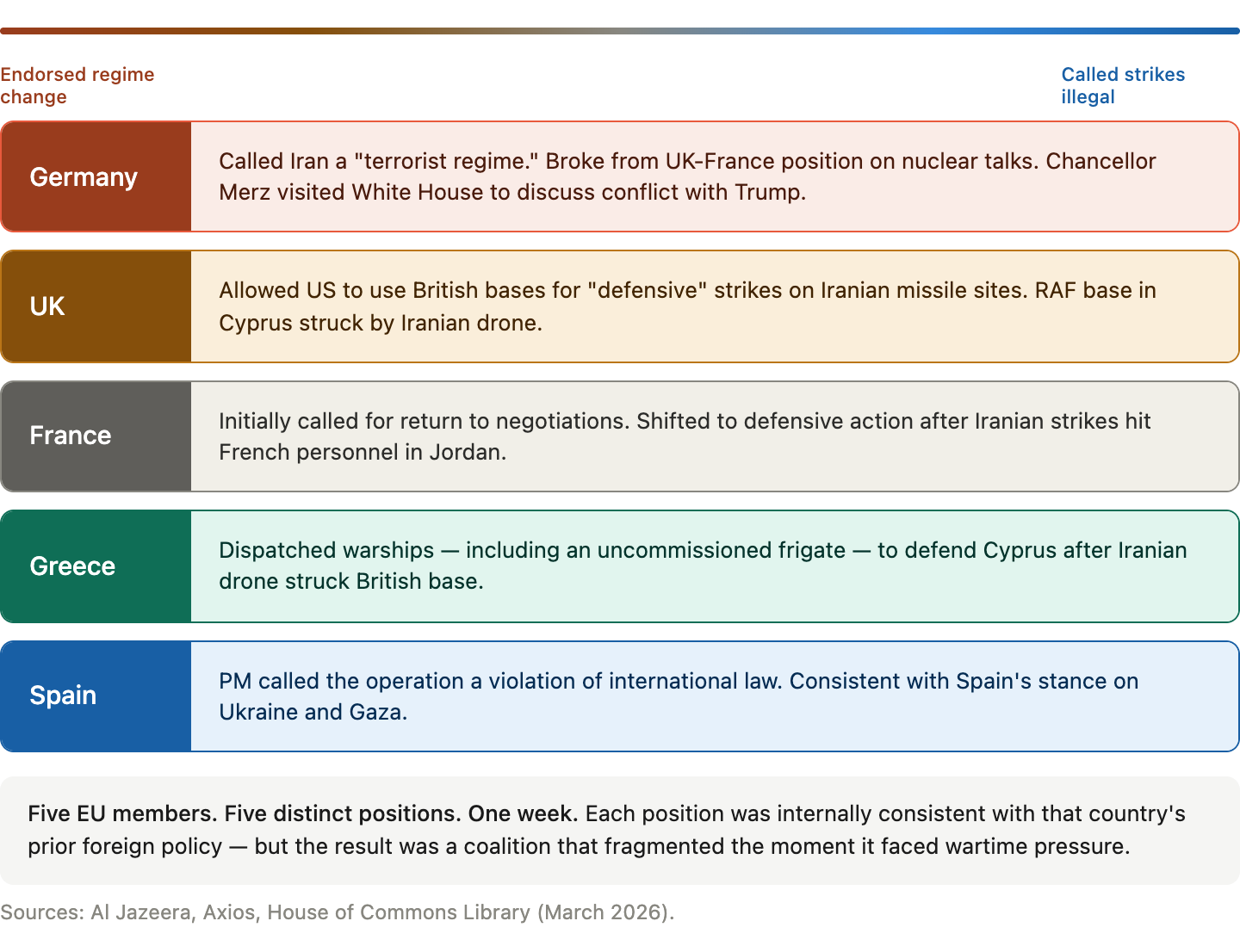
This is the Cuba/NAM problem from 1979 playing out in real time among the world’s largest coalition. When the conflict is abstract, it’s easy for coalitions to hold. When missiles are falling, individual national interests take over.
Hedging didn’t help
What I find particularly interesting is that the Gulf states are perhaps the best hedged, some of the most politically diversified countries in the world. Gulf states are some of the largest oil producers in the world (everyone needs oil), spent years building bilateral relationships with China and India, investing in their sovereign wealth funds as a store of capital, pursuing energy transition strategies to reduce dependency on any single commodity. The UAE sovereign wealth funds hold nearly $2.5 trillion in assets, making it the third largest sovereign wealth fund in the world. Saudi Arabia’s Vision 2030 is explicitly meant to reduce its oil dependency. Qatar cultivated a reputation as a neutral mediator, maintaining ties with both the US and Iran.
This didn’t matter. The UAE absorbed roughly 800 projectiles. Iranian drones struck Dubai’s Palm Jumeirah, one of the region’s largest commercial hubs. Qatar suspended most natural gas production after drones hit energy facilities. Strait of Hormuz traffic dropped by 80% within days. AWS centers in Bahrain and the UAE were knocked offline. Despite spending years doing exactly what a sound diversification strategy might suggest, the Gulf states were dragged into a conflict because of a military decision they had no say in.
Carney’s own dilemma
When asked whether Canada would participate militarily, Carney said he couldn’t “categorically rule out participation”, while also maintaining US-Israeli strikes were “inconsistent with international law”. This is exactly what his own speech highlighted — alliance loyalty versus principle, leverage versus values.
Taking down the sign
The Iran conflict is the most vivid recent example, but the erosion is broader.
China’s Belt and Road Initiative and the Asian Infrastructure Investment Bank offer alternate narratives to the existing rules-based order
The conflict in Ukraine, beginning with Crimea in 2014 and the full-scale invasion in 2022, challenge the rules-based order’s core principles of territorial integrity
The 2003 US-led invasion of Iraq, widely criticized for bypassing international norms and institutions, seen as a double standard towards Washington’s selective engagement with international legal bodies
Each case, in its own way, reinforces the same conclusion: middle powers need to stop assuming existing institutions will deliver a reasonable outcome by default.
1. Narrow issue-based coalitions beat broad values-based ones
The EEZ worked because the demand was concrete (200 nautical miles), enforceable, and attractive to a broad set of countries that didn’t need to agree on anything else. Ecuador and Kenya didn’t share a language, geographical region, or political system — they shared a coastline and economic interest in their respective offshore resources, and that was enough.
The Non-Aligned Movement struggled with the opposite problem. It was organized around a broad ideal — non-alignment — rather than a specific demand. Any member’s behavior could be read as a betrayal of the movement’s principles. When Cuba voted with the USSR on Afghanistan, the damage wasn’t just to Cuba’s reputation; it was to the credibility of the movement itself. A narrower coalition (eg. commodity producers’ bloc like OPEC) would have been more resilient to this kind of divergence because expectations are only to agree on the narrow issue at hand, not on all aspects of geopolitics.
Practically, this means when middle powers organize around a narrow issue, expectations get calibrated reasonably. Disagreements on other topics are expected, not scandalous. If members of a critical minerals pact disagree on Iran, that’s completely independent from the pact itself. Narrowing the scope of an alliance reduces the problem space available for fracture.
2. Wartime and peacetime collaboration are fundamentally different
The EU has spent years building shared institutions and values — a common market, a shared currency, coordinated foreign policy machinery. In peacetime, this architecture produced genuine alignment: joint sanctions on Russia, coordinated energy and economic policy, collective trade negotiations.
Under wartime, this fractured within days. Germany and Spain ended up on opposite sides of the Iran problem. Germany’s chancellor framed Iran as a terrorist state, Spain’s prime minister called the operation a violation of international law. Both positions were internally consistent with each country’s foreign policy — Germany had been hawkish on Iran’s nuclear program while Spain had consistently prioritized international legal norms across Ukraine and Gaza. But the result was that two EU members took fundamentally opposing positions on one of the most significant military interventions of the decade.
Middle power coordination works well for slow-build peacetime problems: trade, resources, institutional reform, supply chain diversification. It breaks when a great power moves at the speed of military action and forces more binary choices. A realistic middle-power strategy needs to acknowledge this limitation rather than glossing over it.
3. Some risks are structurally unhedgeable
At Davos, Carney said “collective investments in resilience are cheaper than everyone building their own fortresses”. While I generally agree, this naturally comes with its limitations. The Gulf states had done more to hedge their strategic position than arguably any other country on earth. They’ve diversified trading partners, accumulated enormous sovereign wealth, invested in energy transition, and cultivated neutral diplomatic reputations. By any standard measure of resilience, they were well positioned. And yet they still absorbed hundreds of missiles for hosting US military infrastructure in a conflict they didn’t start, didn’t choose, and had limited capacity to influence outcomes for.
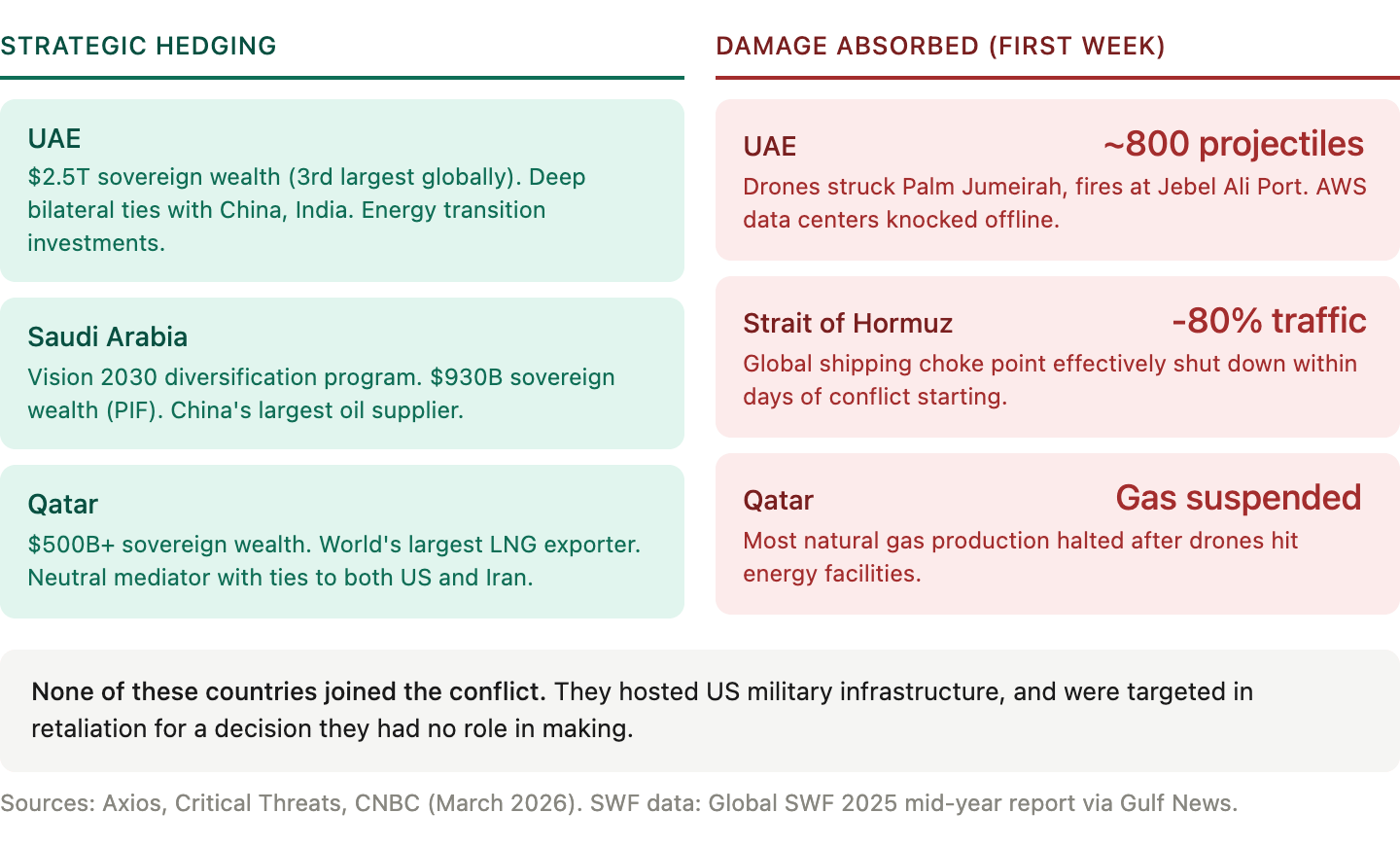
There may be a class of geopolitical risk that is simply uninsurable, where no amount of economic or political diversification will change the outcome. Coalition building might reduce chronic vulnerabilities (trade, supply chain, import/export deficits) but is far less effective against acute vulnerabilities (being in the blast radius of a great power decision made thousands of miles away). A serious middle-power strategy needs to distinguish between hedgeable and unhedgeable risks.
4. The replacement order is a web, not a charter
It’s tempting to look at the erosion of the rules-based order and look for a replacement — the next United Nations, a new set of institutions that bind everyone equally. I’m not sure this is coming.
The order that is emerging is piecewise and multilateral. Over the last few months, we’ve seen various blocs actively diversify away from historical partnerships: the EU signs a free trade agreement with South America, a landmark EU/India free trade agreement, and Canada’s tariff deal with China. The CPTPP continues to expand its membership, while AUKUS deepens security cooperation in the Indo-Pacific. These aren’t a single grand coalition — they’re overlapping bilateral and multilateral arrangements, each organized around specific issues and specific partners.
When you’re embedded in enough overlapping agreements — on critical minerals with one set of partners, on defense another, on trade with a third — no single power can cut you off from everything. Strategic autonomy comes from the density of your network. Middle powers shouldn’t wait for a single institution to replace the UN or WTO; they should keep building bilateral and multilateral agreements that, in aggregate, create a safety net these universal institutions used to provide.
5. Great powers pay some compounding cost for coercion
At Davos, Carney said “Hegemons cannot continually monetize their relationships”. Every time a great power weaponizes its economic or military ability, it erodes its position and incentivizes the rest of the world to seek alternatives. When the US and EU froze $300 billion in Russian central bank reserves after the invasion of Ukraine, the message was that dollar- and euro-denominated reserves could be seized at any time if you end up on the wrong side of Western policy. When the US leveraged the SWIFT payment system as a sanctions tool, China’s Cross-Border Interbank Payment System (CIPS) saw adoption rise 43% YoY with transaction volume tripling since 2020. When the US imposed tariffs as a negotiating tool against allies and adversaries alike, it pushed the EU, Canada, and others to diversify their trade relationships. Each act of coercion, regardless of its justification, accelerates the diversification that reduces the coercer’s future leverage.
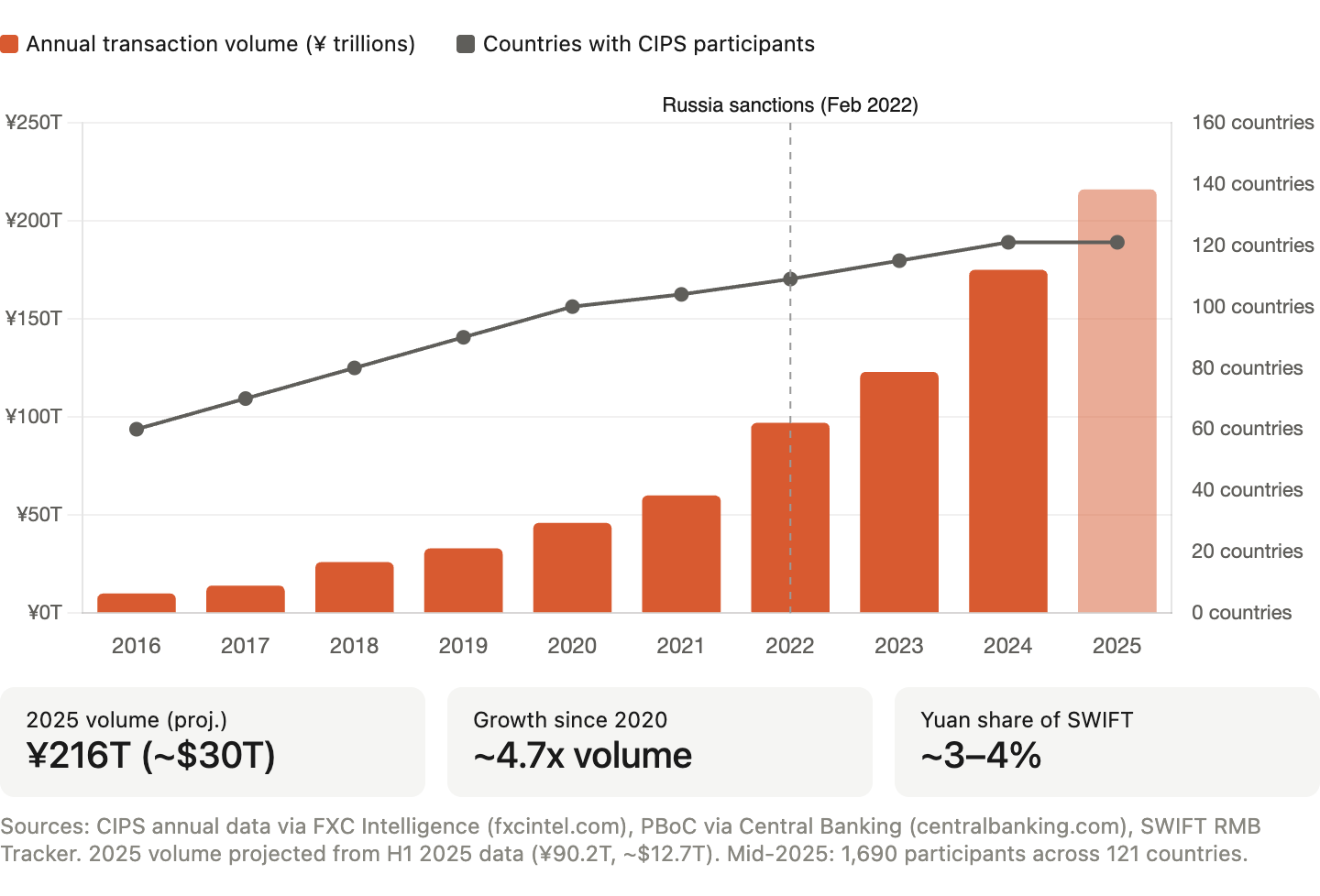
Coercion clearly works near-term. But there’s some compounding cost like bacterial resistance where these very tools become less potent with each use as the rest of the world routes around them. Middle powers don’t need to win a direct confrontation with a great power, they just need to ensure coercion becomes progressively more expensive by building alternatives that reduce their exposure. The dollar is still dominant. SWIFT is still critical (the Yuan only accounts for 2% of global SWIFT payments vs 41% in USD). But both are less dominant and less critical than a decade ago.
When the sign comes down
My defense of middle powers isn’t tied to nostalgia for the old system, however well that worked for western liberal democracies. It’s a claim that even a ruptured order still has rules — they’re just enforced differently. A proper middle-power strategy, implemented correctly, is more resilient than it might look after a week of missiles over the Middle East.
The historical record speaks for itself: the EEZ, ASEAN, the EU, even the NAM all demonstrate that countries without hegemonic power can still influence the systems they operate in. This can be achieved through narrow, issue-specific, coalition-building that makes the status quo more expensive to maintain than the alternative.
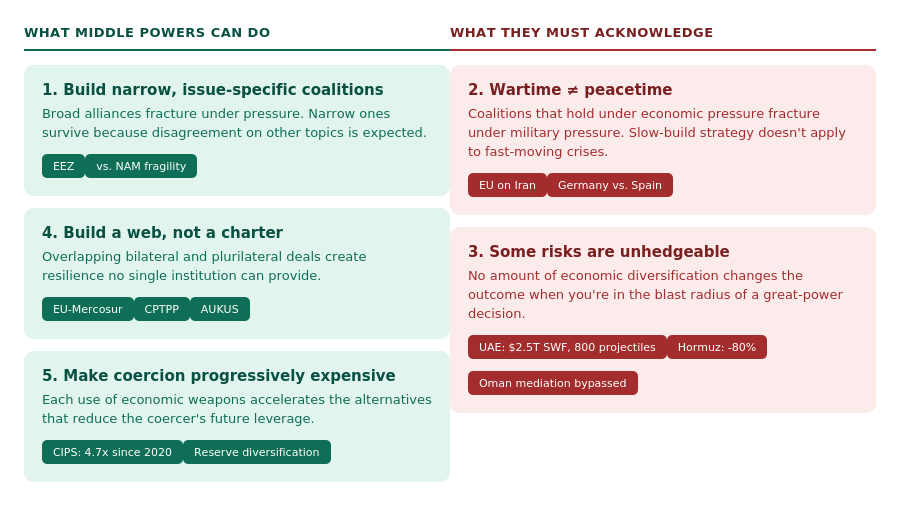
Where this framework breaks down is equally clear: when unilateral action leads to fast moving military action, slow-build coalitions can’t keep up. No amount of institutional design would’ve given middle powers a voice in the 72 hours between mediation and the first strikes. This is a real limitation, and a strategy that only works during peacetime feels incomplete.
But incomplete isn’t the same as useless. If middle powers build enough overlapping commitments on trade, resources, energy, security — when the next crisis arrives, they have more options than they did last week. Middle powers are not meant to build a single grand alliance, but a dense resilient web of arrangements that no single actor can unravel. Raising the cost of coercion, narrowing the space for unilateral action, ultimately tilts the playing field back toward a world where arguments matter just as much as raw power.
Thanks to Claude for editing, graphics, and research help.
Lowy Institute (2021), Parley Policy Initiative (2023), Brookings (2024), International Security (2025), Ray Dalio (2026), Vox (2026)