

On February 22, 2026, a single Substack post wiped roughly $285 billion off the market in a single trading session. The post — “The 2028 Global Intelligence Crisis” by Citrini Research’s James van Geelen and Alap Shah — amassed 28 million views on X and sparked a broad selloff across software and payments stocks, despite being completely hypothetical. Perhaps that’s what makes it compelling.
A claim that’s entirely wrong is usually obvious, and easy to dismiss. But a claim that’s mostly right — grounded in data, built on plausible mechanisms, extrapolating from trends that genuinely exist — is almost impossible to resist. These claims are dangerous precisely because the big picture makes sense — just plausible enough to feel prophetic, built on a plethora of subtle assumptions that, stacked together, produce a conclusion far more dramatic than any individual assumption warrants.
Of course, writing the compelling half-truth is only half of the trick. The other half is waiting for the internet to take the bait. Apparently I couldn’t resist either. So here we are.
What the Citrini report argues
The report is written as a fictional macro memo from June 2028. In their scenario, the S&P 500 has fallen 38% from their highs in 2026, unemployment has hit 10.2%, and a self-reinforcing “intelligence displacement spiral” has gutted the economy.
AI inference costs plummet through model distillation, open-weight proliferation, and hardware improvements. AI agents become cheap enough to deploy everywhere, and a Claude agent does the work of a $180k/yr product manager for $200/month.
Agents reshape consumer spending habits. When agents make purchasing decisions, consumer inertia disappears. Brand loyalty, unused subscriptions, paying for convenience — all behavioral friction becomes a thing of the past. Credit card interchange fees are bypassed via stablecoins. The result is a rapid, unstable transfer of value away from intermediaries.
Private credit and PE-backed SaaS bets blow up. During the AI boom, private equity loaded up on software at multiples assuming sticky enterprise customers and recurring revenue growth. When AI reduces switching costs and makes it easier to move tasks in-house, the $500+ billion SaaS linked private credit trend toward default.
Underlying mortgages begin to default — even prime. Displaced white collar workers, who historically anchored the $13 trillion residential mortgage market, see their incomes structurally impaired. As a cornerstone of the economy, prime mortgages that have gone decades without a real default cycle start cracking.
Government revenue shrinks as general labor income falls. The government lacks both the fiscal capacity and political consensus to respond. By the time it begins to react, the deflationary spiral has already set in.
This argument is powerful because all these pieces compound: cheap inference leads to a proliferation of AI tools → encourages agent-driven spending optimization for individual consumers → corporate revenue collapse → private credit defaults → mortgage stress → impaired federal tax revenue → leading to a cycle with no real backstop.
Citadel’s rebuttal
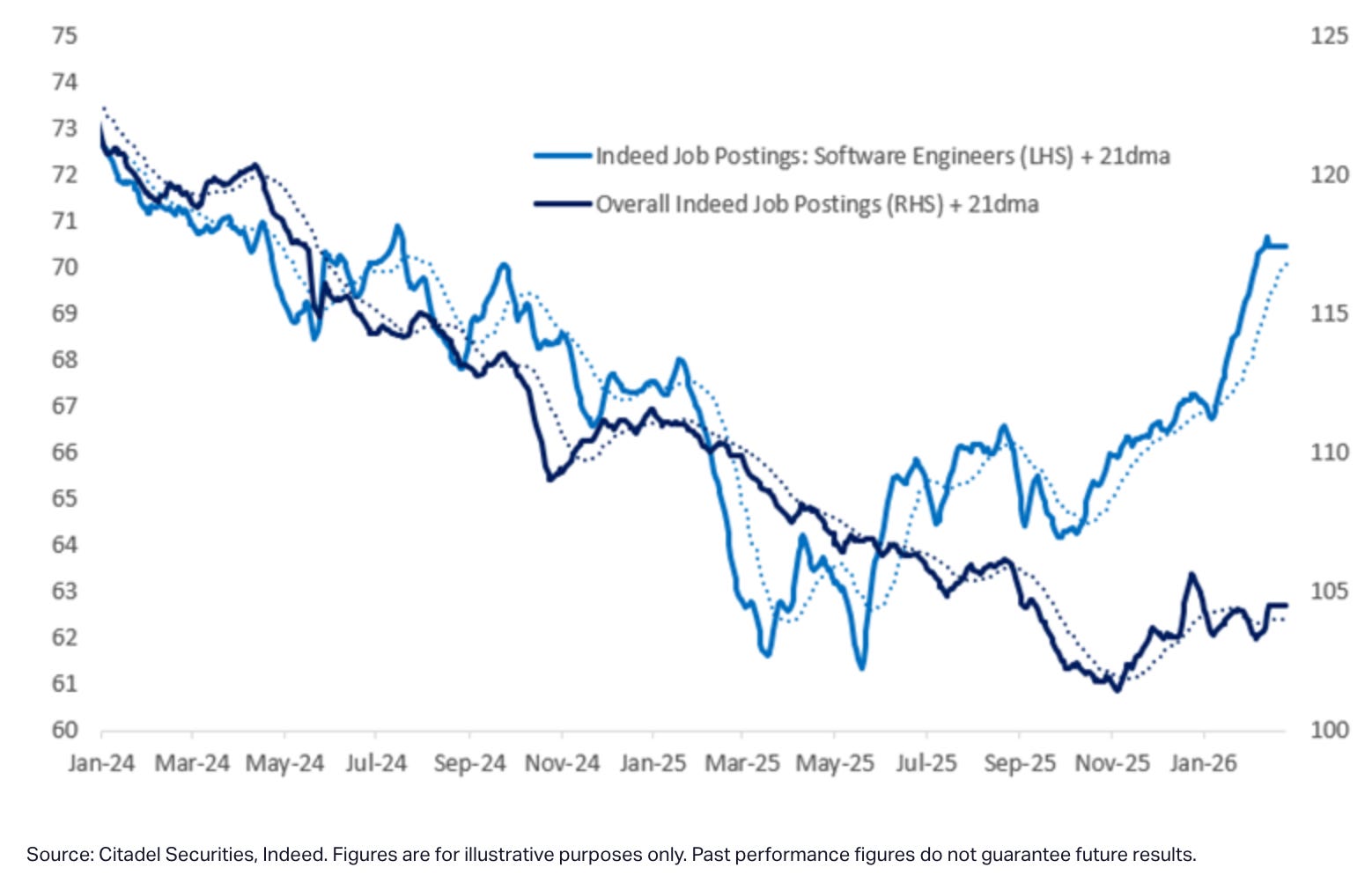
Just two days later, Citadel Securities published a swift rebuttal by strategist Frank Flight. Flight’s argument was grounded in real-time data: Indeed job postings for software engineers were up 11% year-over-year in early 2026, daily AI usage for work remained “unexpectedly stable” with little evidence of displacement, and new business formation was expanding indicating solid output (and no collapse in consumer demand). Flight compares Citrini’s prediction to Keynes’ vision of the 15-hour workweek — directionally right about increased productivity, fundamentally wrong about the labor market and elasticity of demand.
Two partial pictures
Both pieces are sophisticated. Both have real merit. Yet both are, in their own way, built on half-truths.
Citrini’s scenario rests on aggressive assumptions about human behavior, institutional fragility, and the speed of technological adoption. Among other things, it assumes:
AI agents will autonomously route around every friction in the economy within 18 months
displaced workers won’t adapt, retrain, or find new roles in time
the federal government will sit paralyzed while unemployment doubles
Each individual assumption is defensible as a possibility; stacked together, they produce a parlay that requires everything to break in the same direction, at the same time, at the same speed.
Citadel’s rebuttal has the opposite problem: it’s rigorously data-grounded, but that’s precisely its weakness. Flight cites Indeed job postings for software engineers up 11% year-over-year as of January 2026. But Stanford/ADP payroll data shows employment for 22-25-year-old software developers fell roughly 20% between their late-2022 peak and late 2025. Both numbers can be simultaneously true: Indeed captures demand signals (job postings) while ADP captures actual payroll outcomes. The leading edge of displacement might be concentrated among junior workers in ways aggregate posting counts don’t capture.
More broadly, Flight cites the St. Louis Fed finding that AI diffusion remains “unexpectedly stable” as evidence against imminent disruption. But the fact that most companies aren’t deploying AI at scale today doesn’t mean the risk isn’t building under the surface. McKinsey reports 88% of organizations are experimenting with AI — but only 6% report measurable PnL impact. MIT’s Project NANDA found 95% of organizations see zero bottom line effect from AI investments. This gap between widespread experimentation and minimal production deployment represents enormous latent potential. When enough companies cross the threshold from “trying it out” to “replacing headcount”, the shift could be abrupt and sudden rather than a gradual shift. Citing current diffusion rates as evidence of safety is like measuring today’s snow depth on a mountainside and calling it stable — the avalanche risk isn’t in the accumulation, it’s in the moment it crosses a threshold.
The core issue is that Citadel argues from where the economy currently is. Citrini argues from where it could be going. Neither shows the whole picture. The strongest version of the case against Citrini doesn’t rely on a snapshot of today’s data — it grants the most aggressive assumptions and shows the mechanism still breaks.
Even if AI capabilities advance as fast as Citrini claims, the physical world imposes speed bumps
Citrini’s scenario requires AI systems that are “substantially smarter than almost all humans at almost all things” by 2027, with ubiquitous AI agents running continuously for every consumer and business. Many (including myself) actually feel pretty bullish about this prospect from the model intelligence front; but growth demands an enormous amount of physical infrastructure that hasn’t kept up.
Start with the chips themselves: NVIDIA’s datacenter revenue is up 75% YoY in Q4 FY2026 ($62B) and Blackwell GPUs are backordered through 2026 and demand for compute massively outstrips production capacity. Even if wafer fabrication scaled overnight, downstream bottlenecks like TSMC’s advanced chip packaging (CoWoS) remains sold out through 2026, with CEO CC Wei saying demand outstrips supply by 3x. High-bandwidth memory is similarly depleted through 2026 across all major producers. These aren’t bottlenecks that resolve with a purchase order — packaging facilities and HBM fabs take years to build, meaning even the hundreds of billions pouring into AI infrastructure today won’t fully clear the backlog for over half a decade.
The harder constraint is electricity. PJM Interconnection, the largest grid operator in North America serving 67 million people across 13 states, failed for the first time in history to source enough power to meet its reliability targets, falling 6.6GW short. Data centers can be built in 12-18 months, but new power generation takes 4-7 years from the initial interconnection queue request to commercial operation. The interconnection queue is the waitlist of projects that have applied to connect to the grid; when a developer wants to build a new generator (solar, wind, battery, gas) and connect it to the transmission grid, they can’t just plug it in — operators (ISO/RTOs) need to run an interconnection study for thermal overloads, voltage, or stability problems to ensure grid safety. The US queue contains 2,300 GW of proposed generation capacity (twice the existing grid capacity), none of which can be utilized until they become operational. Over 70% of interconnection requests get withdrawn because of bureaucratic red tape and aging infrastructure. Microsoft sits on $80B in unfulfilled Azure orders because it can’t source enough power for its GPUs; Citrini’s world of ubiquitous AI can’t exist with a backlogged grid unable to keep up with power demands.
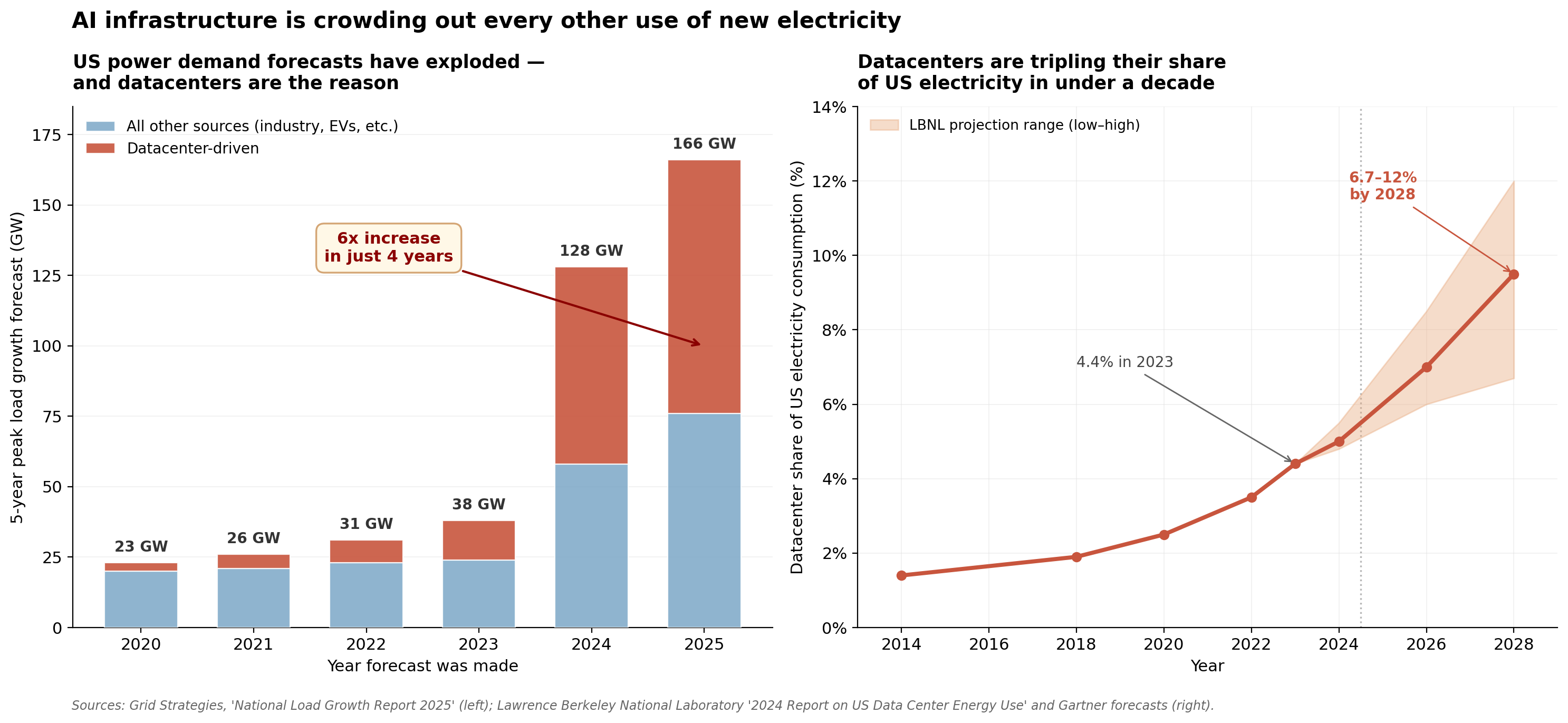
The point here isn’t that Citrini’s 2028 time horizon itself is wrong — any specific date is beside the point. It’s that the physical supply chain makes the kind of transition Citrini describes — sudden, binary, all-encompassing — structurally implausible. Chips, packaging, memory, and power all impose their own multi-year buildout cycles, and not all of these can be solved in parallel. AI adoption is unlikely to arrive as a single wave that crashes over the economy all at once; it’s likely to roll over unevenly, across different sectors, constrained by hardware that takes years to manufacture and infrastructure that takes even longer to build. This unevenness is what gives workers, firms, and governments time to adapt (and Citrini assumes we won’t have time for).
Even if compute constraints are solved, Citrini models a closed economy (contrary to reality)
Citrini models events almost entirely within the US — white-collar workers in Manhattan losing their jobs, American mortgages defaulting, collapse of domestic consumer spending. But the world economy isn’t a closed system and the geography of AI displacement introduces more complexity than the memo describes.
The first wave of AI displacement isn’t necessarily San Francisco’s product managers; it’s more likely outsourced services workers in Bangalore and Manila. India’s IT sector — $280 billion in revenue, 5.8 million workers, nearly 8% of GDP — has already been impacted. The top 4 Indian IT firms have shed over 42,000 jobs in two years while revenue per employee climbs. Indian IT stocks lost $54 billion in market cap in February 2026 after the Citrini report. In the Philippines, the $40B BPO sector faces similar pressure — as do Indonesia, China, Eastern Europe, and others. A joint International Labor Organization - World Bank study covering 135 countries found offshore workers tend to “perform fewer non-routine analytical tasks” and do “more routine or manual work”, and an MIT report found the jobs AI substitutes first are overwhelmingly “already low priority or outsourced”. Lower complexity, offshore jobs are intuitively the first set of tasks at risk of being replaced.
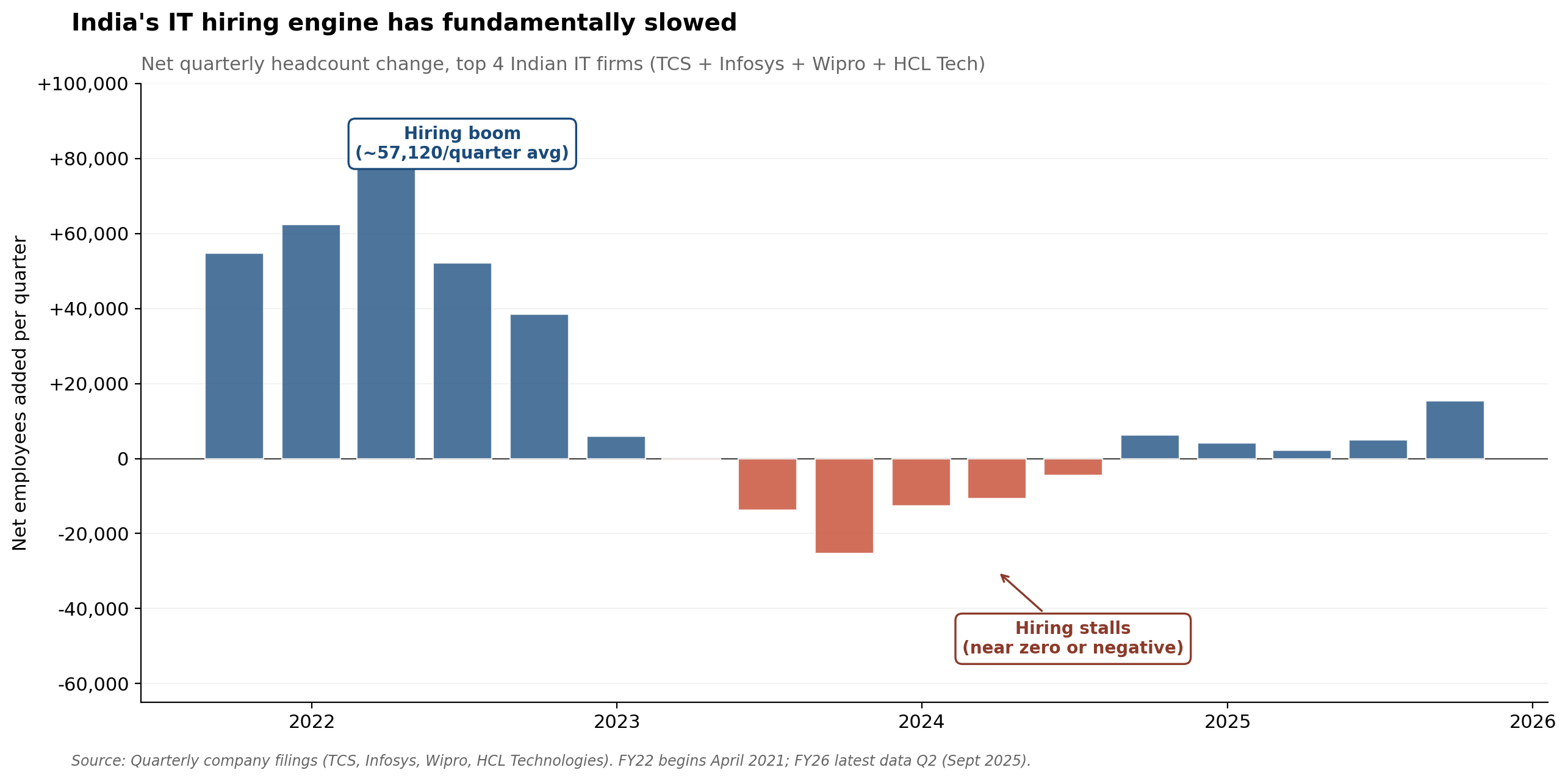
These facts complicate Citrini’s doom spiral because they seem to support an inverted order of operations. AI automates the most routine tasks first, and these tasks are disproportionately performed offshore. As the world’s largest (and arguably most skilled) economy, many of the white-collar tasks performed domestically would only get automated when much of the remaining work in the world has already been covered. It’s the global services economies — India’s IT sector, the Philippines’ BPO industry, Eastern Europe’s outsourcing hubs — that are the first dominos to fall. For AI displacement to trigger the kind of US economic collapse Citrini describes, it would first have to work its way through the entire global services workforce, disrupting economies of tens or hundreds of millions of people. Global disruption at that scale doesn’t occur silently, nor overnight — it triggers adaptation at every stage. Governments respond, workers retrain, new industries absorb displaced labor. By the time AI displacement reaches US knowledge workers in force, the world economy might have already been adjusting for months to years, diluting and redistributing the shock long before it concentrates into the acute crisis Citrini describes.
Beyond geography, there’s a second source of friction that slows the trickle further: AI is currently more expensive than the human workers it’s replacing. Nvidia’s VP of AI infrastructure Bryan Catanzaro recently acknowledged that “the cost of compute is far beyond the costs of the employees”. Concretely: the bills for power-user Claude or ChatGPT subscriptions easily reach $100k+ per month for token costs of heavy automation workloads. By comparison, an offshore virtual assistant in the Philippines costs $1,000-2,000 per month. Obviously these perform tasks of drastically different complexities, but that’s to say this dynamic forces some equilibrium. Companies that push past this threshold get punished — Klarna replaced 700 customer service workers with AI in 2023, only to reverse course and rehire by 2025 with cost and quality issues. Gartner predicts 50% of companies that cut jobs for AI will rehire by 2027. This cycle of firing, rehiring, cost reductions, quality improvements, and firing again plays out over years rather than months. The cost curve is falling fast, but in the meantime, AI could be replaced by the very same workers it replaced.
Between geographic ordering and economic equilibrium, the path to US white-collar displacement is rate-limited by multiple factors. By the time AI displacement reaches US knowledge workers in force, other parts of the world economy would have already spent years adjusting, diluting, and redistributing this shock before it concentrates into the acute crisis Citrini describes.
Even if compute and globalization are solved, the crisis scenario still requires simultaneous failures
But let’s grant Citrini everything so far — let’s assume compute scales fast enough and globalization doesn’t diffuse displacement as much as we’d hope. This kind of catastrophic collapse still requires several structural pieces to collapse at the same time: the real economy, the financial system, and the government. These assumptions are weaker than they appear.
#1. Citrini confuses the cost of intermediation with its function. Take the credit card argument — Citrini envisions AI agents routing around Visa and Mastercard, settling transactions on stablecoins, eliminating the 2% interchange fee. Visa and Mastercard shares fell 5% in a single session on this thesis. But credit card companies do much more than just move money: they provide fraud detection, KYC, transaction dispute resolution, and chargeback guarantees. If your AI agent commits you to a $50,000 purchase from a counterparty you’ve never met, who bears the liability of that transaction? Crypto proponents would point to smart contracts, decentralized arbitration protocols, on-chain reputation systems — but these solutions haven’t replaced Visa at a consumer level despite decades of development, precisely because they’re brittle in ways that don’t yet work. Smart contracts can’t adjudicate ambiguous disputes, decentralized arbitration hasn’t seen participation at scale, and DeFi’s own track record — billions in exploits and rug pulls — is itself evidence that this infrastructure isn’t ready for mainstream commerce. Throw in autonomous agents making microsecond commitments on behalf of users that don’t get a chance to understand what they agree to, and the trust problem gets harder, not easier. AI might compress the cost of intermediation, but its function — trust, verification, liability — becomes even more necessary in a world of autonomous agents.
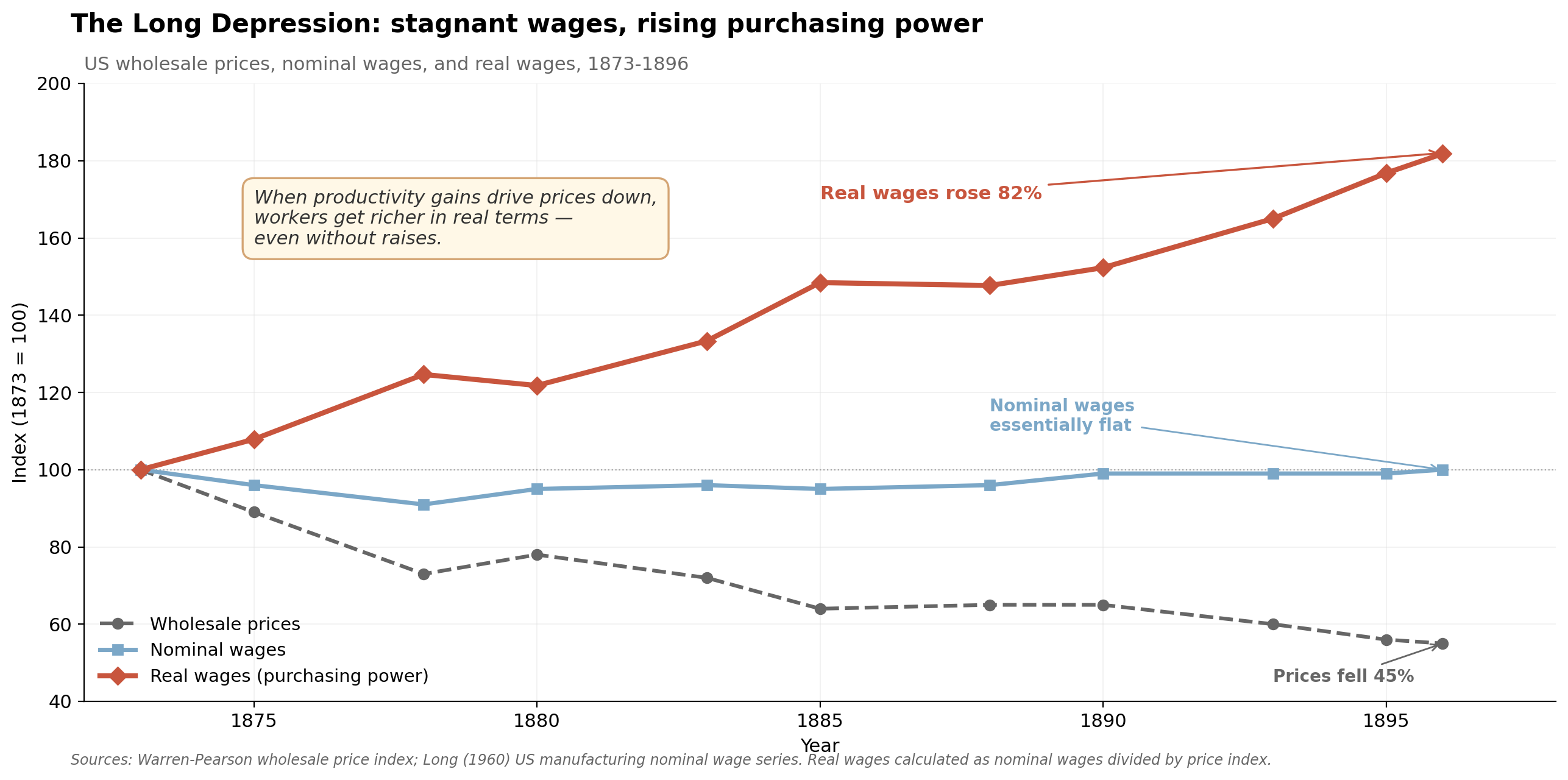
#2. Citrini models falling income without modeling falling prices. Citrini tracks nominal income destruction without considering the real income effects of AI-driven deflation. If AI collapses the cost of legal services by 30-50% or software development by 15-20%, in this world the purchasing power of an equivalent (or diminished) salary also goes meaningfully further. When the price of a good/service falls, each dollar of income buys more of it. A worker earning $60,000 in a world where legal advice, accounting, software, and financial planning cost half what they do today is strictly richer in real terms than a worker earning $90,000 today for those spending categories.
This dynamic has played out historically. The cost of compute has fallen ~a trillionfold since the 1960s, which is why a minimum-wage worker now carries more processing power in their pocket than NASA had during the Apollo program. Food went from 40% of household budgets in the 1900s to 10% today — not because wages increased, but because agricultural productivity collapsed the real cost of food. Even during Engels’ Pause — a period during the Industrial Revolution when real wages of the British working class remained stagnant while per-capita GDP grew and wealth accumulated amongst capitalists — the simultaneous fall in price of manufactured goods like textiles, tools, and other household items cushioned the effect of stagnant wages. Workers were poorer relative to output, but richer in terms of what their wages could buy. Citrini’s model captures the income side of the equation while ignoring the corresponding deflationary effects on the price side.
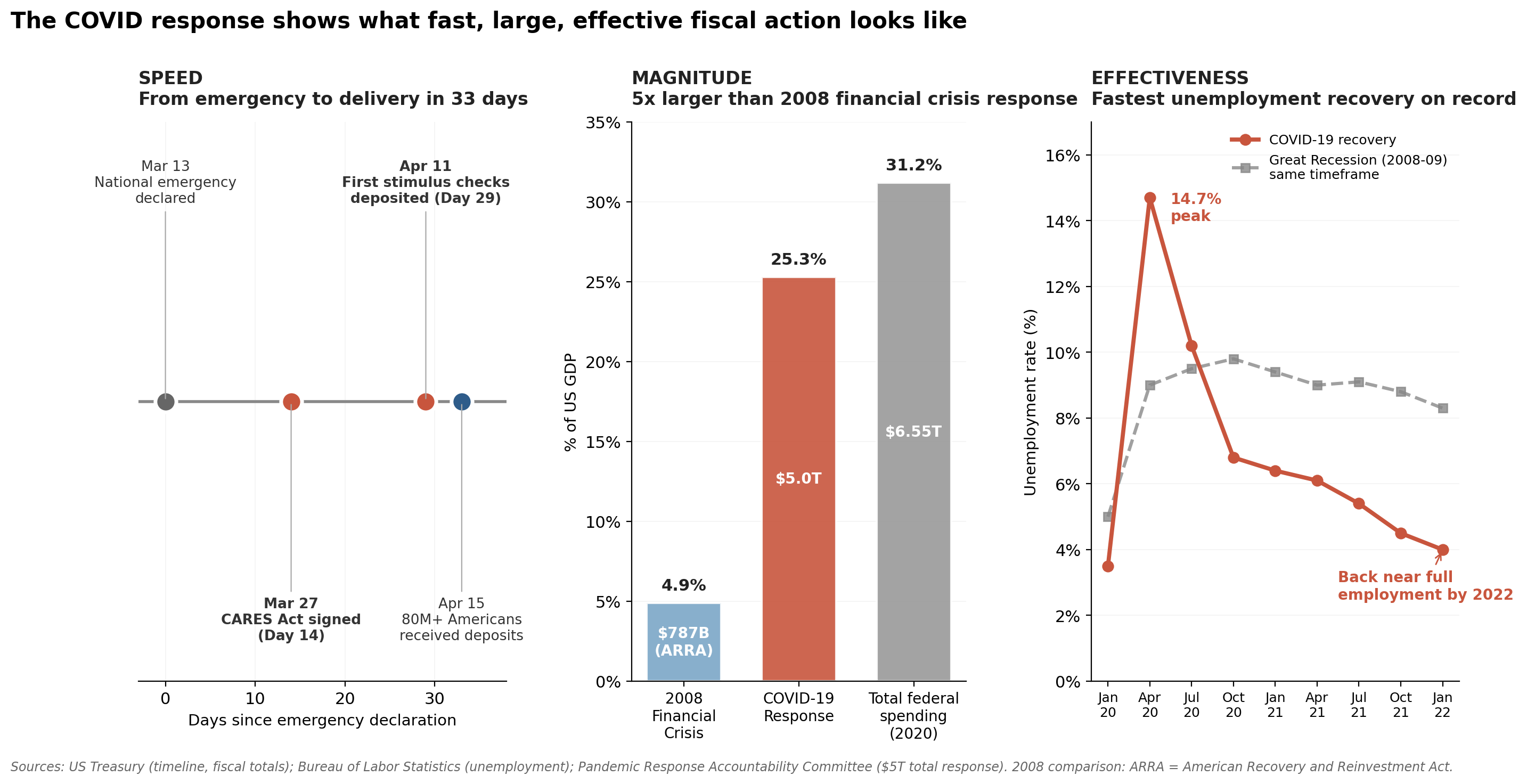
#3. Government can and will respond. Perhaps the memo’s most implausible assumption is that policymakers sit frozen while unemployment doubles. The current political landscape feels more fractured than ever, but we can’t forget that our policy arm is still capable of moving fast. During COVID the timeline from declaring a national emergency (March 13, 2020) to the CARES Act signing was 14 days. The first direct-deposit stimulus payments hit bank accounts on April 15, only 33 days after the emergency began. Over 80 million Americans received electronic deposits within 3 weeks of the bill’s passage. Total pandemic fiscal response exceeded $5 trillion, nearly 25% of 2020 GDP. By comparison, we’ve argued Citrini’s scenario will be a slower, more predictable deterioration giving policymakers even more lead time to react.
Citrini argues governments could struggle to respond because tax revenues fall alongside employment. During COVID, the federal deficit tripled to $3.1 trillion in FY2020 as tax revenue fell and spending surged; the government spent $5 trillion anyway because the binding constraint on crisis spending has never been revenue, it’s inflation. Governments aren’t afraid of running massive deficits during a crisis but are generally constrained by the inflationary effects during the recovery. And Citrini’s own scenario is deflationary; in a world where AI collapses the cost of goods and services, deficit spending is less dangerous than before.
Remember: fiscal and policy intervention doesn’t need to solve AI displacement. It just needs to slow the feedback loop long enough for the other forces we’ve described — falling prices that sustain real purchasing power, gradual rather than instantaneous adoption, physical limitations, global distribution of the shock — to prevent the spiral from reaching critical mass. If stimulus checks and extended unemployment benefits prevent displaced workers from defaulting on their mortgages for 12-18 months, the contagion mechanism stalls. We’ve repeatedly seen policy makers deploy this toolkit when unemployment spikes, and in a deflationary world these methods are more viable than before.
A modern Engels’ Pause
If the doom spiral is unlikely to play out as Citrini describes, how do we think about AI displacement?
Lucky for us, there is exactly one historical precedent — a period where technology dramatically increased output while ordinary workers failed to capture the gains. Economist Robert Allen documented it during the British Industrial Revolution, coining “Engels’ Pause” after Friedrich Engels, who wrote about the misery of English factory workers in 1845. Between 1780 and 1840, output per worker rose 46% while real wages rose only 12%. During the worst stretch (1800-1830), real wages remained constant while technologies raised productivity by 0.69% annually. Labor’s share of national income — the portion of economic output that goes to workers as wages rather than to capital owners as profit — dropped from 60% to 50%. This pattern is exactly the scenario Citrini warns about.
But the Pause lasted 50 years, not two. Society adapted through labor organizing, legislative reform, and new industries that absorbed displaced workers. Critically, the Pause ended because the economy ran short of workers to operate all the new capacity enabled by technology, giving labor bargaining power that drove wages up.
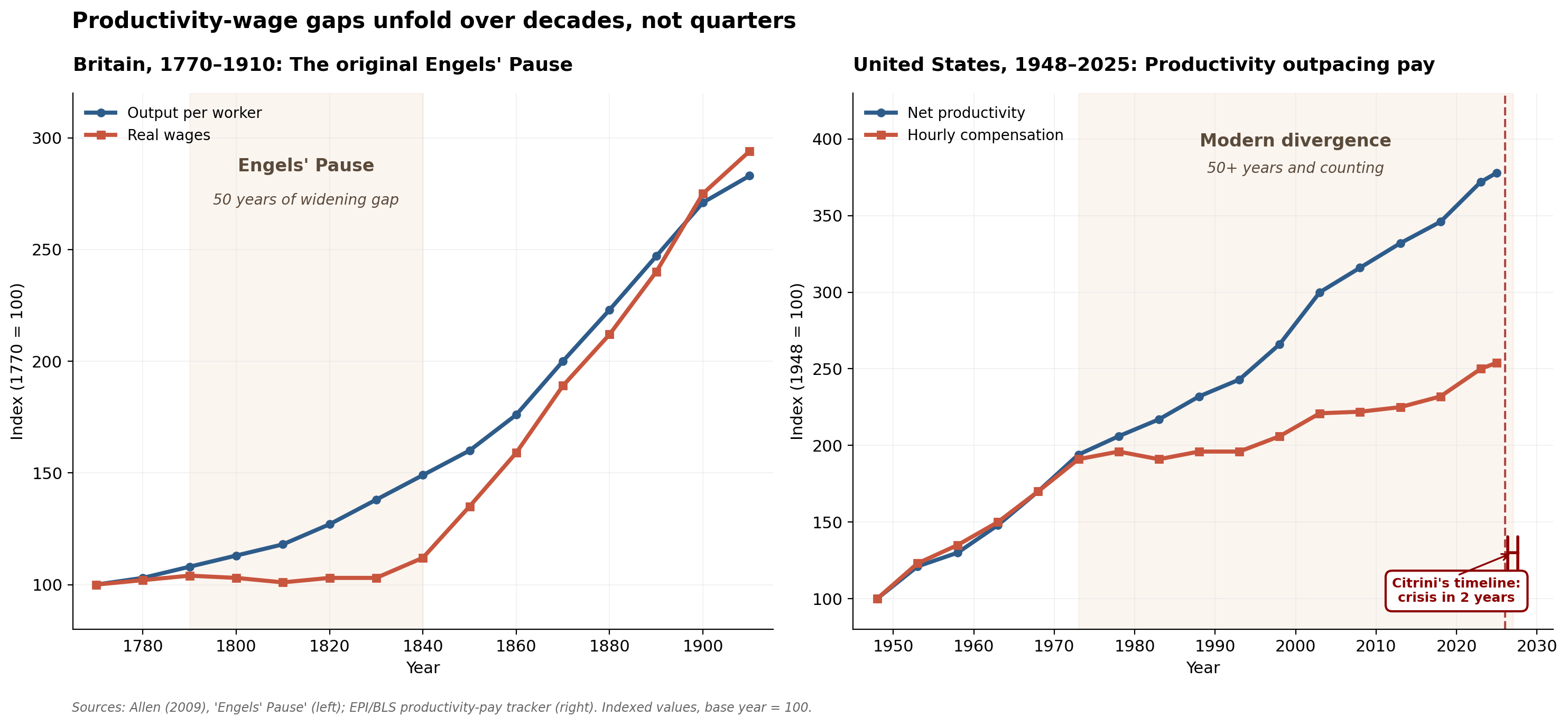
We could be in the early stages of a modern Engels’ Pause. Labor’s share of US GDP hit 53.8% in Q3 2025, the lowest on record since the Bureau of Labor Statistics started tracking numbers in 1947. New grad tech workers are already experiencing measurable displacement. Goldman Sachs found no meaningful relationship between AI adoption and economy-wide productivity yet, but localized productivity gains of 30% in software development and customer service indicate the frontier of productivity gains is advancing much faster than the average. The pattern of outsized productivity gains vs relative wage stagnation is unfolding, but slowly — nowhere near the expedited timeline required to trigger Citrini’s catastrophic spiral.
Citrini’s strongest argument is that AI may break the historical cycle entirely. If AI can substitute for human cognitive labor with no intrinsic bounds, that mechanism breaks permanently. Every previous technological transition ran out of tasks to automate or people to operate. AI, in principle, might not. If that’s true, wages never need to get bid up because businesses never need to compete for workers — they can just deploy more agents. The relevant question isn’t whether AI will break this cycle (it will), but how quickly.
The optimist response usually invokes Jevons Paradox: technological improvements make something cheaper, people consume more of it, and total employment in the augmented sector often grows.
ATMs appeared to reduce the number of bank tellers per branch in the 1970s, but banks opened up so many new branches that total teller employment nearly doubled from 300,000 to 600,000 by 2010
Spreadsheets automated bookkeeping yet the number of accountants quadrupled from 339,000 to 1.4 million
But both ATMs and spreadsheets behaved this way because of two specific conditions that may not apply to AI:
Expanding capacity required expanding human labor. ATMs let banks open more branches, but each new branch still required humans to open the office and tellers to staff it. Spreadsheets let firms run more financial analysis, but each sheet still required an accountant to interpret it and present the results. Technology compressed the cost per unit of output, but scaling output still required humans. AI breaks this link: an agent doesn’t just process a transaction faster, for the first time it can own the entire workflow end to end without human intervention. If the marginal cost of additional output approaches 0 in both compute and labor, the mechanism that converted productivity gains into employment growth simply doesn’t exist anymore.
Automation was complementary rather than strictly substitutive. ATMs took over routine cash handling, but tellers moved up the value chain into sales or in-person KYC — work that genuinely required human judgement. Mobile banking only killed tellers when the technology became substitutive rather than complementary, replacing the entire job rather than pieces of it. AI is positioned more like mobile banking than ATMs: it’s no longer handling one piece of the cognitive work, it’s increasingly capable of everything end to end.
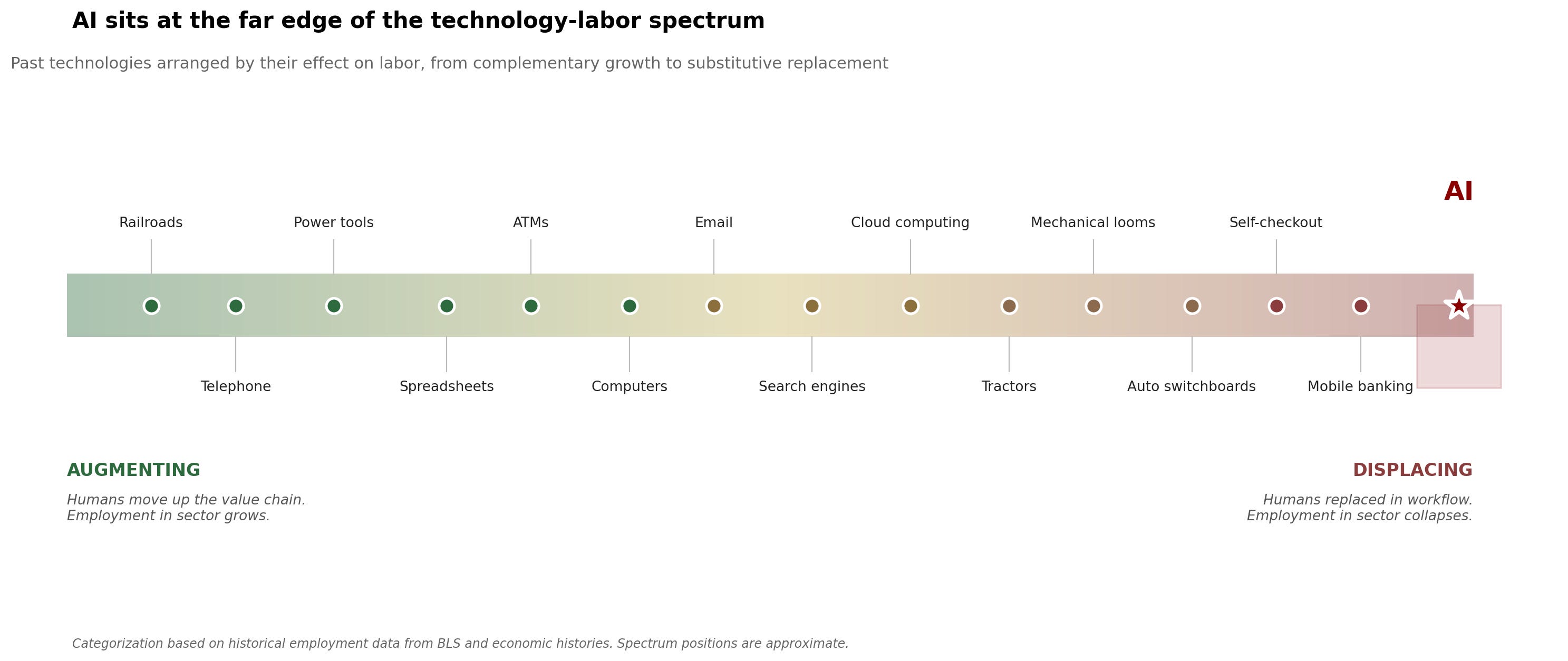
None of this means Jevons effects won’t apply to AI at all. Cheaper cognitive services will unlock categories of demand we can’t yet imagine, and some of those will require human roles we haven’t yet defined. But AI isn’t the next ATM — it’s the next mobile banking, across every cognitive industry simultaneously.
I spent the entire article taking an optimistic view on AI displacement, yet I find myself ending it acknowledging AI is fundamentally different from everything that came before. It could be the first technology in history that breaks the historical pattern of productivity gains translating into employment growth. Citrini’s instinct that something profound is happening feels indisputable.
The report is best read not as a forecast but as a stress test — a thought experiment in pushing our assumptions to some breaking point. The value isn’t in specific features of the end state, but in the assumptions we disagree with and the point at which our mental model diverges from the causal chain. We can’t engage seriously with a half-truth without articulating what we actually believe, which is what makes them so dangerous (and useful). The market reaction revealed how few people had truly thought things through. The $285 billion wipeout reflected investors who hadn’t seriously thought about what AI displacement could look like, so everyone latched on to the most confident viral scenario that came along.
No, I don’t think the 2028 crisis happens as described. The mechanism is too brittle, the timeline too compressed, the world too dynamic. But I do think we’re in the early days of a modern Engels’ Pause: productivity gains decoupling from wage growth, displacement concentrating among new grads and offshore workers, fault lines emerging between the top and bottom quartiles of those who leverage AI. The right response isn’t to dismiss the Citrini scenario as panic, nor accept it as prophecy. The point should be to engage with each link in its causal chain — compute, displacement, contagion, response — and ask which assumptions hold. Whether AI delivers the most productive economy in human history or the most disruptive labor shock since the Industrial Revolution depends less on the technology itself, and more on how seriously we think about these questions today.
Thanks to Claude for editing, graphics, and research help.